Friday, January 11, 2013

Mossback on Why Spokane is Central

You cannot do much blogging about Washington State history without coming across the wonderful work of Knute Berger--or "Mossback" as he would prefer. Berger has been blogging and writing about Pacific Northwest history for years. His focus is usually on Seattle and the Puget Sound, but sometimes he takes a broader view as with his "Heritage Turkey Awards."

Knute Berger. Image courtesy Evergreen State College.
I had the pleasure of finally getting to meet Berger in person at the National Trust Conference in Spokane last fall. He was clearly and openly taken with our city--an unusual response from a west-sider. (I maintain that they are all secretly impressed with Spokane and would move here in a minute but for fear of the mocking from their hipster friends.)

Anyway, Berger went back home and wrote a great piece: Preserving state's heritage: Why Spokane is Central. Here is a portion:

Spokane recently played host to the prestigious National Preservation Conference, put on by the National Trust for Historic Preservation. Heritage advocates from all across the country, including the storm battered East Coast, made their way to the capitol of the Inland Empire. It was a chance for Spokane to show off its preservation efforts and architectural legacy, which has been key to revitalizing its downtown.

Go and enjoy the whole piece, a powerful argument for the importance of historic preservation in reviving American cites, with Spokane as exhibit #1.

Monday, January 7, 2013

Spokane Historical: Houdini Takes a Dive

Last quarter one of my grad students, Lee Nilsson, chose the old Washington Street Bridge over the Spokane River as one of his stops for Spokane Historical. He did not expect to find much--maybe a few old photos and a newspaper story about the construction. As it happened he hit the historical jackpot:


You can view all of the historic interpretation that Nilsson developed for this site at the Washington Street Bridge stop. He also found a treasure trove of bridge construction photographs, and an amusing story in the newspsper that he turned into a "period" radio news flash. Houdini's 1905 jump is only one of the forgotten Spokane stories that my students are uncovering in their research for Spokane Historical.

The other notable thing about the video is the introduction, with the animated logo and historic music.

The original graphics for Spokane Historical were developed by Mark Tebeau and Erin Belle at the Center for Public History + Digital Humanities at Cleveland State University. It was they who developed the Curatascape platform that underlies Spokane Historical, and they host our database and offer technical support. The graphics were animated for me by XX at EWU. He also paired the graphics with various sound clips, but none of the free MP3s sounded quite right. I wanted something historical. So I sent Nilsson to the Cylinder Preservation and Digitization Project, where he selected a clip from a 1913 recording, Alexander's Ragtime Band Medley, to serve as the Spokane Historical theme song.

More great Spokane Historical material to follow!

Friday, January 4, 2013

Spokane's Fantastic Baby Cage

Spokane is proud of its inventors, such as Royal Riblet of the square-wheeled tractor fame and Mary Latham who invented a pessary (and did a lot of other stuff). And yet who among has heard of Emma Read?  I had not, until a great piece by Shawn Vestal in the Spokesman-Review introduced me to this Spokanite's earth-shaking invention. Behold, the baby cage--click for the video:

http://www.britishpathe.com/video/baby-cage/query/baby+cage

"How did this not catch on?" Vestal asks, "If you don’t read those words – Baby Cage – with a secret thrill, with an unspoken recognition that deep in the unexplored reaches of your mind, you always knew that cages were perfect for babies, then I suspect you’re not a parent."

What got me blogging about this topic was Vestal's frustration in trying to find out more about the inventor: "Read herself, as well as any level of detail about the creation of the cage, remains stubbornly elusive. There is no file on her in the newspaper’s archives. She is not mentioned in city histories that I could find. Google her, and you are reminded of two things: Google is not omniscient and about 80 percent of the online world is a vast cavern of echoes."

I took that as a challenge--afer all, digging up obscure Northwest History in the digital realm is the purpose of this blog. So what did I find? Not vey much, in truth, but I did come up with a few gems.

First, the newsreel report embedded above, from 1953. The views of a smoggy, gritty post-war London are as interesting as the cage itself. (Mother, that is not fresh air!) And then there is the original 1922 patent, to which Vestal alludes in his article. The patent is signed by Read, and also by a Watson E. Coleman, who turns out to have been a D.C. patent attorney who advertised his services in western periodicals of the time. From the patent we get the justification for the device:
Be it known that I, Emma Read, a citizen of the United States, residing at Spokane, in the county of Spokane and State of Washington, have invented certain new and useful Improvements in Portable Baby Cages, of which the following is a specification, reference being had to the accompanying drawings:


When baby gets too big you can also raise urban chickens! Read further explains the utility of her invention:
It is well known that a great many dificulties rise in raising and properly housing babies and small children in crowded cities, that is to say from the health viewpoint. This is especially true with reference to babies and young children, who at present are being raised in large apartments... In crowded cities, where the houses are closely arranged, and in large apartments, there is no way for proper ventilation ... to permit the children and babies to receive proper fresh air from outside.
This emphasis on the importance of fresh air was a common argument made by progressives during this time period. I comes in part from the still-believed miasma theory, which held that many contagious diseases were caused by "bad air." Belief in miasma theory was a major impetus to the city parks movement of the late-19th century. But I am getting all professor on you.

There are also a lot of great images out there of baby cages--which never seem to have been widely used, but were always photogaphed on the few occasions they did appear!

You laugh, but this child grew up to be Superman!
What of Vestal's challenge to discover more about the Spokane connections of the fabulous baby cage? Ancestry.com has an Emma K. Read of Spokane who might be our woman. If so, she at some point moved to Seattle where she died in 1956. And that--is about it. I can find no mention of Read in the digitized newspapers for early Spokane--though the common surname of Read, along with the fact that it is also a common verb ("to read a book"), makes for a messy search. There are a lot of men named Read in early Spokane, some of whom may have been relations. I don't find a birth or marriage certificate for Emma Reed at the Washington State Archives--and we would have them if they existed. She appears to have had no other patents. I could buy a subscription to Ancestry.com and view census records and the like and come up with further information, but I am cheap.

The cold digital trail for Emma Read makes two points. One is how little historical record most people leave, even the inventor of the baby cage. The other is that you cannot do all of your reseach online. My wife was quick to point out that you could find a lot more about Read with a trip to the Northwest Room of the Spokane Public Library or the MAC. A search through old city directories will reveal when and where Read lived in Spokane, her marital status, her occupation, and who else lived in the building. (See this entry for Etta Read as an example.) Only a few years of the directories for Spokane are digitized. From there one could go to Sanborn Maps, which have richly detailed illustrations of each city block. Did Read live in a downtown apartment? And did she have a baby? And with names of relatives and dates and such, one could look for ancestors, who might have more information.

Some of my readers have proven much smarter than I am. Can anyone find more information about Emma Read?

Thursday, January 3, 2013

John Muir Biographer Coming to Aunties


This just in from Auntie's Bookstore:
You are cordially invited to a free author presentation, Q&A and book signing by James B. Hunt, professor emeritus at Whitworth University on Saturday, Jan. 12, 2:00 pm at Auntie's Bookstore 402 W. Main, Spokane WA. Before he achieved fame as an environmentalist, John Muir lost his sight in one eye, left his job as a machinist and walked across the South after the Civil War. Join us to learn more as Hunt presents his book, Restless Fires: John Muir's Thousand-Mile Walk to the Gulf in 1867-68.
Muir's 1867 walk to Florida was an turning point in the life of America's great naturalist, and the subject of Muir's book A Thousand Mile Walk to the Gulf. It is also an interesting episdoe in Muir's life in that it took place jsut two years after the end of the Civil War, and Muir trod across a South that was in many ways barely recovered from the conflict. (Muir himself had fled to Canada to avoid service during the war.)

Muir's walk can also be explored as a digital project. Here is a Google Earth file that includes a map of his route. And here is a short video of an exhibit in Oakland that overlays some of Muir's California drawings with Google Earth. And of course the Sierra Club has an extensive set of resources about Muir.

Come out and support our independent bookstore on the 12th!

Heritage Conference at the Western Washington State Historical Society

The Washington State Historical Society (or as we on the east side know it, the Western Washington State Historical Society) is hosting an interesting two-day conference February 4th and 5th. The Art of Heritage conference will take place in Olympia. The WWSHS conference page does not include a descriptive overview for some reason, but the excellent Department of Archeology & Historic Preservation blog fills the gap:
The Washington State Historical Society is partnering with the Washington State Arts Commission, the Washington State Arts Alliance and Washington Museum Association for the 2013 Heritage Conference “The Art of Heritage” at the Red Lion Hotel in Olympia on Tuesday, February 5, 2013.  
The Conference also features workshops on Monday, February 4, 2013 on Collections Care and Effective Grant Writing at the State Capital Museum in Olympia. 
At the conference on February 5th, attendees will learn how to work effectively with elected officials, how to implement social media; get an update on lodging tax; learn about initiatives to build new audiences for arts and heritage; see how other arts and heritage groups have used state grants; get some tips on board development; and enjoy a special session on “Museums, Arts and Historic Sites Synergy.”
The spotlight event will be a noon keynote address on February 5th  by noted author Carol Kammen, American Association of State and Local History columnist who writes “On Doing Local History.”  She will speak on “Clio and Her Sisters:  Integrating Arts and Heritage.”
Sounds like a worthwhile event. I find that such smaller, focused conferences are far more worthwhile professional events, both for information and for networking, than are impersonal national gatherings. I can't make this one, maybe a reader will catch me up with what happened?


Tuesday, January 1, 2013

Crowdsourcing Civil War History in the Northwest

Oregon and Washington Territory in 1862. Courtesy Wikimedia Commons.
Here is an innovative public history project! The Washington Territorial Civil War Read-In is an attempt to crowd-source research into a little-understood period of Northwest history--the Civil War era. Though the Washington Territory saw no battles during the war, the whole northwest was awash in political intrigue, desertion, etc. Yet there is little in the way of published research. The Civil War era in the northwest suffers from a not-uncommon problem: Everybody knows there is nothing to find, so no one goes looking.

At last fall's Conference on Pacific Northwest History, Dr. Lorraine McConaghy, representing the Washington State Historical Society, announced an ambitious plan to crowd source historical research into the Civil War era in Washington Territory--a "read-in" that will recruit hundreds of volunteers to dig through historical collections and combine their research. Here is the FAQ from Lorraine McConaghy and Darby Langdon. At the bottom is their contact information if you want to participate!:


Washington Territorial Civil War Read-In: Frequently Asked Questions

Welcome!  If you’re interested in this FAQ, you’re considering volunteering as a reader for the Read-In.  I hope that you will read with us.  

The Washington Territorial Civil War Read-In is a project of the Washington State Historical Society to involve hundreds of citizens in documentation of the territorial experience of the late antebellum, wartime and early Reconstruction periods.  This project is an opportunity to participate in conducting basic research, in doing history from scratch.  For so long, Washington Territory’s Civil War experience was dismissed as marginal at best, beneath notice at worst.  But over the last five years, as we have moved toward the Civil War’s sesquicentennial, we’ve learned enough about Washington Territory during the wartime period to know that there are great stories waiting to be discovered in the record.  No one person could possibly read everything of interest, so we’ve invited hundreds of you to work together to frame the territorial experience of the Civil War.  Among us, we will leave a lasting legacy to the future. 

Interested?  Please keep reading….


What was the Civil War in Washington Territory?
Between 2011 and 2015, Americans commemorate the sesquicentennial – the 150th anniversary - of the Civil War.  Most Americans – including Washington residents – think of the Civil War as a war of battles.  Since there were no battlefields in Washington, they reason, there was no experience of the Civil War here.  However, a quick review of the primary sources for Washington Territory, from the Dred Scott decision in 1857 to five years into Reconstruction, 1871, shows deep difference of opinion about the issues that led to war.  Wherever settlers came from, they brought the ideas of the Civil War with to Washington Territory – they brought the war as surely as they brought garden seeds and butter churns.  Their ideas and convictions were captured in territorial words and deeds, and can be rediscovered.

Convictions about race and slavery, treason and secession, military preparedness, international relations and wartime suppression of civil liberties divided settlers in Washington Territory as they divided Americans in the Confederate States of America from those in the United States.  Washington’s governor resigned to “go South,” and so did many officers of the U.S. Army and U.S. Navy who had been stationed in Washington.  Not every settler partial to the Confederacy or opposed to the Lincoln administration left the Territory.  Those who stayed behind ranged across a spectrum from Peace Democrats to the secret, paramilitary society known as the Knights of the Golden Circle, extremists who drilled for the assassination of Lincoln’s political appointees and advocated the secession of the Pacific Republic.  

There was one celebrated fugitive slave case on Puget Sound, and at least one other African-American slave in the Territory.  Settler attitudes toward race were enormously complicated in Washington Territory, where the racial hierarchy included Asians from the “Sandwich Islands,” Native and mixed world people, blacks from Africa, and African-Americans, slave and free.  While some Republicans were abolitionists, few at any point on the political spectrum were advocates of black social, economic or political equality.  In other words, one could oppose slavery but not favor free blacks.  

As far as we know at present, no anti-war, anti-Lincoln newspaper in Washington Territory was shut down by military authority; the northernmost newspaper to be closed was the Portland Advertiser in the new state of Oregon.  Territorial residents had subscribed by mail to the Advertiser as well as a number of other Oregon antiwar newspapers; Republican appointees delivered the mail in Washington Territory and were partly responsible for the suppression of those newspapers, seen as treasonous.  And, as far as we know right now, there were no territorial instances of the suspension of habeas corpus.  

The Crown Colony of Victoria was the destination for at least one fugitive slave from Washington Territory, fleeing to a substantial black community; however, Victoria was also the haven for pro-Confederate sympathizers and Confederate agents, seeking to purchase and equip a war steamer to harass coastwise shipping. 

The Washington Civil War Read-In is intended to increase our understanding of these and other topics.  Here are some of the questions to be explored:
  • What were the political attitudes in the territory prior to the war?  How did settlers perceive the issues?
  • What issue-related or war-related evidence is there for the economic and political development of Washington Territory during the war?
  • What were the experiences of people of color in Washington Territory?
  • Washington Territory’s first governor, Isaac Ingalls Stevens, headed the national campaign in 1860 for John Breckenridge and Oregon’s Joseph Lane – the southern Democratic ticket.  Territorial residents could not vote; did they have opinions about this campaign?
  • Who “went South?”  Who “went North?”  Who left the territory and headed back east, to fight on either side?  Can we find evidence that soldiers and sailors corresponded with settlers in Washington territory?
  • What pro-Confederate activities can we document in Washington Territory during the war?
  • What was Washington Territory’s military history during the war?
  • What was the territorial effect of the Homestead Act?  The arrival of the telegraph?  The chartering of the Northern Pacific railroad?
  • What were the war-related activities of women in Washington Territory?
  • What evidence can we find for the Knights of the Golden Circle or other such extremist groups in the Territory?  Did the Knights disappear, or morph into something else?  (For instance, is there a link to the postwar Ku Klux Klan?)
  • What were the racial attitudes in Washington Territory?  Did wartime events like the Emancipation Proclamation have any effect here?
  • What evidence can we find for or against secession of Washington, Oregon and California as the Pacific Republic?
  • What was the political history of the Territory during the war?  Did the Republican appointees get along?  How about the out-of-office Democrats?
  • What effects did the Civil War have on Native people in Washington Territory?
  • How did settlers respond to the assassination of Abraham Lincoln?
  • How did settlers regard the Crown Colonies and the Hudson’s Bay Company, 1857-1871?
  • Who were the early veterans who immigrated to Washington Territory after the war?  Which army or navy had they served in?  Where did they settle?  What did they do for a living?
  • Can we find evidence that the Ku Klux Klan arrived postwar with Confederate veterans?  Or by any means?
  • How did Washington Territory’s demography change after the war?  So from census to census, 1860 to 1870?
  • Is there evidence in current or past place names to show areas of settlement by either Confederate or Union veterans in the Territory?
  • Were there any veterans’ groups or organizations in Washington Territory prior to 1871?

And many, many more questions, that we can’t anticipate because we don’t know what you will find.

What is this Read-In about, in a nutshell?

The Read-In is a statewide program of the Washington State Historical Society to recruit and train hundreds of readers throughout Washington State to carefully read newspapers, archival collections and Washington history classics to find evidence concerning Washington Territory’s experience of the Civil War.  The Read-In will take place from January through August, 2013.  The readers will build a database of citations and scanned documents, which will be hosted by the Washington State Historical Society.

How will readers be trained?

Every reader must attend a day-long training at one of the eight sites, listed below.  YOU MUST REGISTER TO ATTEND A TRAINING – PLEASE DO NOT SIMPLY SHOW UP!  The training will include a presentation sketching what we currently know about the Civil War in Washington Territory, 1857-1871.  Then, readers will work through three case studies – in a newspaper, an archival document and a classic of Washington history.  They will practice the hard work of figuring out what evidence is in the selections, and how to record the required information in the digital format.  Then, they will be trained in logging that data and uploading it to the Omeka holding queue, our online database.  At the end of the training session, each reader will receive his or her assignment.  The assignment is designed to be carefully read in a month of spare time, but the reader may take as long as two months to complete the reading and review.  There will be plenty of time at the training for questions and discussion – the Read-In is a community, not just a project. 

Here are the training dates, times, and locations – please note that the second Seattle training is on a Wednesday and the Walla Walla training is on a Sunday. 

Saturday, February 9, 10-4 Seattle
National Archives and Records Administration, 6125 Sand Point Way, NE Seattle 98115

Wednesday, February 13, 10-4 Seattle
National Archives and Records Administration, 6125 Sand Point Way, NE Seattle 98115

Saturday, February 16, 10-4 Vancouver
Clark County Historical Museum, 1511 Main Street, Vancouver 98660

Saturday, February 23, 10-4 Olympia
Washington State Capital Museum, 211 SW 21st Avenue, Olympia 98501

Saturday, March 2, 10-4 Tacoma
Washington State History Museum, 1911 Pacific Avenue, Tacoma 98402

Sunday, March 10, 12-6 Walla Walla
Fort Walla Walla, 755 Myra Road, Walla Walla 99362

Saturday, March 23, Yakima
Yakima Valley Museum, 2105 Tieton Drive, Yakima 98902

Saturday, April 13, 10-4 Cheney
Washington State Archives – Eastern Regional Branch, 960 Washington Street, Cheney 99004

Saturday, April 20, 10-4 La Conner
Skagit County Historical Museum, 501 South 4th Street, La Conner 98257

Choose your training, and email us to let us know! 
So that’s Darby Langdon dlangdon@seanet.com
Lorraine McConaghy  lmcconaghy@wshs.wa.gov

Sunday, December 30, 2012

So What is Happening with Spokane Historical?

Come and explore Spokane Historical!
Spokane Historical is a smartphone app and website for local history, and is a project of the Public History program at Eastern Washington University. It has been awhile since I blogged about this project, and there is a lot to report.

There are now over 150 high quality points of interpretation, or "tour stops" on Spokane Historical. All were created by EWU students in public history courses. I have given students a pretty free hand in choosing their topics, and I am pleased with the diversity of topics. In Spokane we have everything from a tour of the historic parks and Fort George Wright to stops along the Art Walk and many historic buildings and events.

Spokane Historical also includes substantial content in Cheney, including downtown landmarks such as the Odd Fellows Building and Bill's Tavern. We have interpreted over a dozen sites on the EWU campus, including Showalter Hall, the JFK Library, and Jore School--the one-room schoolhouse on the Cheney campus.

There is so much terrific content on Spokane Historical that for the next few weeks I will feature a series of posts about the project. But you don't have to wait for me--go ahead and take a look around.

Sunday, December 16, 2012

Where Would You Film a Spokane Tilt-Shift Video?

You know those tilt-shift, time-lapse videos your friends are always sharing on Facebook? Neat, aren't they? I particularly like this one, filmed in Chicago:


What I love about it, beyond the technique, is how many iconic Chicago landmarks make an appearance. We see Navy Pier, Lakeshore Drive, the L, amd lots of Chicago architecture.

If you were going to make a film like this in Spokane, where would you film it? What places have both iconic imagery that says Spokane, but also some sort of interesting activity and movement that lends itself to this sort of film technique? Off the top of my head, a tilt-shift, time-lapse video of Spokane could include:

  • people walking on the footbridge over the upper falls
  • the gondolas over the lower falls
  • the parking lot at SFCC filling up and emptying out
  • kids sledding at Manito Park
  • cars skidding on the snow on the South Hill
  • trains passing through town, and over Latah Creek
  • kayakers at People's Park
  • folks crossing the bridge at Bowl and Pitcher
  • downtown pedestrian and automobile traffic
  • the rides at Riverfront Park
  • sunset over Spokane from Palisades Park
  • cars going around the curves on the Mount Spokane Road
  • cars passing through an espresso stand
What else? And who is to make this film? It sounds like a good class project for some film class at one of the colleges. Get busy, someone!

Wednesday, December 12, 2012

Scraps of History

I was searching for something else entirely and came across this little item from the December 3, 1940 issue of the Spokesman Review:


What a proud and handsome young man! I had to wonder though--what fate befell this young man who entered the Army Air Corps a year before Pearl Harbor?

The Army Air Corps was expanded by Congress in 1939, and Croteau, a recent graduate of Gonzaga University, was one of hundreds of new pilots being recruited. Kelly Field was a training base in San Antonio. As Croteau went to Kelly Field, Europe was awash in war, the Japanese Army had conquered much of China and southeast Asia, and the United States was preparing to enter the global conflict. So what happened to our smiling lad from Wallace?

Croteau was assigned to the 83rd Squadron, 12th Bomb Group (M), of the 9th United States Army Air Force at Ismailia, Egypt. He piloted a B-25 in support of allied troops at the Battle of El Alamein. I know this because of this web page that describes the wartime service of Roland Rakow, the lower turret gunner on Croteau's bomber. Let's let Rakow tell the story:

On September 1, 1942, as our B-25 was returning from its second completed mission—dropping its bomb load on tanks, trucks and troops on the front line at El Alamein—it was struck by a German anti-aircraft 88 mm shell on the left side of the aircraft, adjacent to the top turret gun position. The shell made a gaping hole, which caused the aircraft to break open and go into a 30-or 40-degree dive. 

The bombardier, navigator, and the top turret gunner were unable to leave the aircraft. The pilot, co-pilot, and I (the radio operator) parachuted to the ground. We sustained wounds and injuries. “The aircraft crashed in the desert. Capt. Croteau—who was slightly injured—and Lt. Biers located the crash site and found the bodies of Lt. McPartlin and Lt. Archer still in the aircraft. Not wanting to leave their bodies, they buried them at the site. Sergeant Andersen’s body was not found. 

I had parachuted to a different location. Within a short period of time, Capt. Croteau and Lt. Biers were discovered and taken prisoner by the German Army. Subsequently, they were transported to a German POW camp and they remained there for the duration of the war.

Rakow was sent to a prison camp in Italy from which he eventually escaped, making his way back to Allied lines and was returned to the States for medical treatment. At the end of his narrative he notes: "I have never been in contact with Capt. Croteau or Lt. Biers, the remaining survivors of my B-25 crew. However, I did hear from other members of our 83rd Squadron that Capt. Croteau had passed away."

B-25s of the 12th Bomb Group over North Africa, 1944.
Courtesy Wikimedia Commons
Croteau had not passed away, however. He survived the war and returned to the Northwest. Croteau married, had a child, worked for Uniroyal and Delta, and lived until 2006, when he died at the ripe old age of age of 87 in Beaverton, Oregon. Here is his grave. His obituary notes that he was a prisoner of war for 32 months. Croeau lived for over 64 years after he was shot down, wounded, and taken prisoner in 1941, and more than 60 years after his crew mate Rakov reported his death.

Monday, December 10, 2012

Historic Photos from Lake Roosevelt National Recreation Area

[Update 12/10/12: I added a few lines beneath some of the photos to answer a few questions.]

Friday was a good day, I got to watch one of my public history graduate students, Clayton Hanson, defend his MA project and complete the requirements for graduation.

Clayton has combined his studies at Eastern Washington University with a series of seasonal positions with the National Park Service, where he has specialized in helping parks use new media to better serve the public. His MA project was a portfolio of some of the digital work he has done, including interpretive guides for the NPS on the use of social media, some clever historic site interpretations at Spokane Historical, quire a few Facebook posts for Lake Roosevelt National Recreation Area, and quite a bit else. One of his digital media projects was to organize the Lake Roosevelt's photo collection put the highlights online, which he did at Lake Roosevelt National Recreation Area's photosets on Flickr.

There are some wonderful historic images there, and I wanted to share a few here:

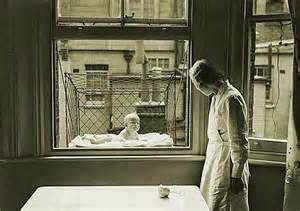
'Dr. A. D. Snyder and daughter Hope' from the Indian Tuberculosis Hospitalset.
Fort Spokane was established in 1880. By 1898 it had become a boarding school for American Indians, and in 1909 it was converted to a tuberculosis sanitarium for American Indians.

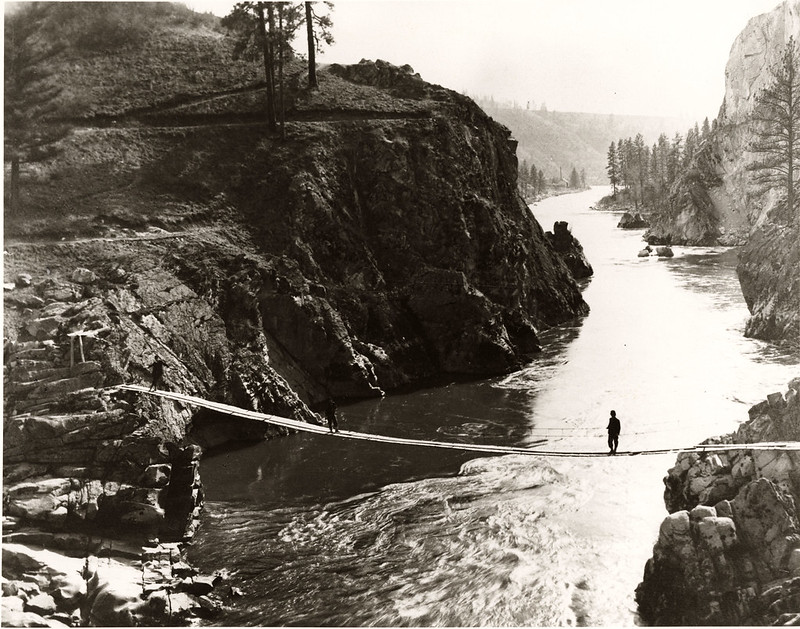
Footbridge over Spokane River narrows, 1910


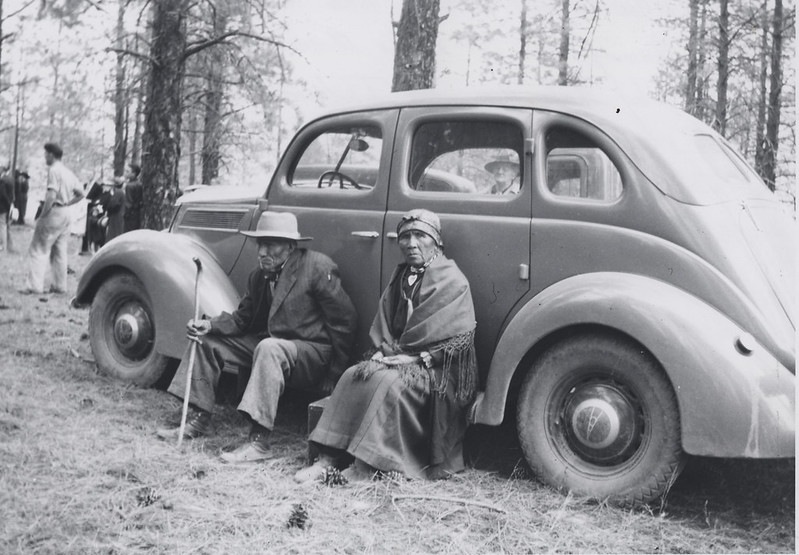
Augustine (?) and Augusta (?) Williams at mourning ceremony at Kettle Falls, June 1938
The "mourning ceremony" was held by Indians as the slack water of the Grand Coulee Dam rose and covered Kettle Falls, where Indians had fished for salmon for thousands of years. To thousands of Indians, construction of the dam was then end to a traditional way of life.

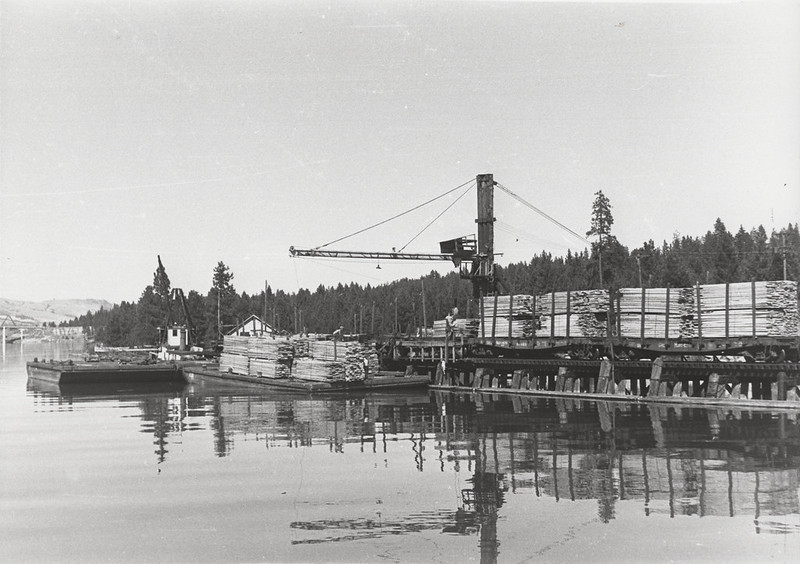
Lafferty Transportation Company docks at Kettle Falls, 1955
Fort Spokane Baseball Club, 1894

There are so many additional wonderful images, go ahead and explore a while. And congratulations Clayton!


Tuesday, December 4, 2012

Spokane Valley, 1857

So I was fooling around at the National Archives website the other day and found this:


Isn't it lovely? This watercolor was painted around 1857 near Plante's Ferry across the Spokane River, and is surely the earliest depiction of Spokane Valley. If you click through to the original record you can zoom in and explore this very detailed painting. Can you find the two men in a canoe? The wagon road?

The image reveals a lot about the environment at that time. I tweeted the image and the helpful @doigSt identified the mountains: "Signal Point, Blossom Mountain & the 2 Mica Peaks." He also asked why there are so few trees in the image. The almost complete lack of trees in the valley would have been due to native burning. Plateau Indians typically set periodic fires to many areas to shape the land to their needs. Regular burning created a purposeful mosaic of prairies and forest that created environments rich in game animals and popular plant foodstuffs.

I believe the painter must have been part way up the same bluff where Spokane inventor Royal Riblet built his mansion. Riblet is a great local character, the inventor of the chair lift and many other, often less practical, inventions. Perhaps I will head out with my camera and see if I can rephotograph the same area from the same location. In the meantime, here is the approximate same view in Google Earth:


Saturday, November 24, 2012

Will Old Bessie Survive Nuclear War?

Courtesy of the Internet Archive, this is a reel of civil defense commercials created for rural farmers in 1965. They are delightfully crude and fairly begging for a mashup. I love the mono-filament fishing line!

Wednesday, November 14, 2012

Auntie's to be Flooded


On Saturday, November 17 at 2 p.m. geologist Bruce Bjornstad will be giving a talk, Powerpoint and Q&A session at Auntie's Books. The topic is his latest book, On the Trail of the Ice Age Floods: Northern Reaches. This guidebook details sites near Cheney, Spokane, north Idaho, and the channeled scab lands that are accessible to visit and study the effects of the calamitous flooding of prehistoric Lake Missoula.

The floods are of course responsible for much of the unique topography of the inland Northwest, as well as our bath tub ring of mammoth skeletons. You can learn more at the Ice Age Floods Institute.

This is a fascinating topic, as well as an opportunity to support our local independent bookstore! See you there.

Friday, November 2, 2012

National Trust Conference, Day 2: Native Canoes and World's Fairs

Big day at the National Trust. The only way I will complete this post is if I summarize everything ever so concisely...

Future Bing Crosby Theater, host to Conversation Starters
A special feature of this conference are the morning "Conversation Starter" sessions. These begin at 8:30, have no competing events (other than field sessions) and have a reading list provided beforehand. I missed yesterday's conversation starter, Good vs. Good on Public Lands, so made sure to catch Telling Richer Stories of Place today. Participants included Keith Magee from The National Public Housing Museum, Edgar Garcia of the City of Los Angeles; Michelle Magalong from My HiFi in Los Angeles, and Aissia Richardson of  Uptown Entertainment in Philadelphia.

It turned out that "Richer Stories of Place" meant including more non-white actors in our stories of place--which is a worthy goal. We heard a lot of interesting stories about oral histories, working with some very dilapidated properties, and trying to bridge the chasms between developers, community groups and preservationists. My favorite line from the session was when Richardson recounted how she would urge community organizations to participate in planning by telling them: "If you are not at the table, you are on the menu."

For my mid-morning session I checked out Indigenous Cultural Landscapes: New Ideas on Place. The presenters were from a variety of organizations around the Chesapeake Bay, working together on the Piscataway Cultural Landscape Initiative, which seeks to become a national model for working with native cultural landscapes. It was a fascinating and wide-ranging session. I especially appreciated Deanna Beacham's obwervations on the Park Service's 1963 Leopold Report, which advocated caring restoring public lands "to primeval wilderness." Beacham noted that "wilderness" is not even a word in native vocabularies, and called the Leopold report "profoundly ignorant" on native shaping of the North American landscape.
1968 dedication of Piscataway Park

The other great thing about the Cultural Landscapes sessions was this--they left time for and solicited audience interaction. About half the session was set aside as a conversation, and session facilitator guided what was absolutely the best audience-panel interaction I have ever seen at a conference. Well done.

At noon I checked into one of the 25 minute power sessions at the exhibit hall, this one a demonstration of the National Public Housing Museum's 3D laser scanning project. The YouTube we watched is here. The short version is that the museum, which hope to renovate an abandoned Chicago public housing project into a museum, partnered with the Visual and Spatial Technology Centre (VISTA) at the University of Birmingham to create an extraordinarily detailed 3D scan of the building, used in planning and fundraising and to give remote visitors a 3D immersive experience.

My first afternoon session was Washington's Maritime Heritage, which described the work that has gone into a proposed Washington State Maritime Heritage Area. You can read the report here. I cannot do justice to this rich session in a few sessions. The high point was seeing the blending of historic sources and GPS and other technologies that went into identifying and mapping the 2300 miles of shoreline and 500 historic properties in the initial survey.

I have been thinking about a northwest National Heritage area for some time, so I took a lot of notes. Watch this space for a future plan.

Dare the Bubbleator!
Finally, I attended Landmarks of the Future: The Heritage, Legacy and Promise of World’s Fairs. This session featured Knute Berger, author of the terrific Mossback blog as well as Pugetopolis: A Mossback Takes on Growth Addicts, Weather Wimps, and the Myth of Seattle Nice, and Bill Youngs, author of The Fair and the Falls: Spokane's Expo '74 : Transforming an American Environment. The two compared the Seattle's and Spokane's fairs in 1962 and 1974. Seattle's theme was the future and the long-term goal was to leave Seattle with the seeds of its high-tech future, such as the monorail that would eventually link the entire region, the Space Needle, and the Bubbleator. a dozen years later Spokane focused its fair on the environment, with the long-term goal of transforming a tangle of rail yards and parking lots into Riverfront Park.

Honestly I was blown away by the interest and quality of the sessions today. This is my first National Trust conference, but already I am making plans for next year, in Indianapolis.

National Trust Conference, Day 1: Historic Trails, Atomic Bombs, and Some Questionable History

The National Trust for Historic Preservation is in the house! This is one of the largest conferences that Spokane has hosted, certainly the largest history-themed conference, and it seems to be going really well. Today I gave a presentation, learned about plotting historic trails, explored three sites of a proposed new national park, heard some dubious historical interpretation, and met a lot of interesting people.

I only attended half the day today, and my first activity was presenting at my own session, Using Mobile Interpretation to Strengthen Preservation Communities. Here are the slides--though I am not sure how much sense they make without my presentation:


In the afternoon I attended two sessions. Happy Trails! Going to Great Lengths to Preserve National Historic Trails was fascinating but should have been subtitled Going to Great Lengths to FIND National Historic Trails. The three panelists described their work on three historic trails--Dave Crowley of the BLM on the Oregon Trail, Angie Krall of the Forest Service on the Old Spanish Trail, and Julie McGilvray of the NPS on the Butterfield Stage Route. What fascinated me was the incredibly painstaking work each person did with old maps, surveyors notes, and painstaking archaeology to pinpoint the routes and campsites of these long-vanished routes. Their identifications hinged on such items as a copper shell casing, a broken Spanish bridle bit, and a shard from a whiskey bottle. Locating these routes is fine-grained detective work.

My second afternoon session was  Interpreting the History of the Atomic Age. This session featured presenters for the three sites of the proposed Manhattan Project National Monument. Ethiel Garlington explained some of the preservation issues at Oak Ridge in Tennessee, Colleen French ("I'm just a girl who fell in love with a reactor") explained the special problems at Hanford where historic preservation takes a necessary back seat to cleaning up hazardous materials, and Heather McClenahan told us about Los Alamos.

I have to think that this session was planned, earlier in the year when proposals were submitted, as an announcement of a new national park. As late as this summer it seemed like the proposed park was on the fast track. But in September the bill failed, at least for now, partly on the objections of Congressman Dennis Kucinich. "At a time when we should be organizing the world toward abolishing nuclear weapons before they abolish us, we are instead indulging in hideous admiration at our cleverness as a species. The Bomb is about graveyards, not National Parks," said Kucinich. The Park Service will likely try again, but for now there is no Manhattan Project Park

One of the reasons for the failure was unintentionally made clear during the session, where two of the five presenters engaged in weird digressions from their subjects to deliver endorsements of the decision to drop the atomic bombs on Japanese cities. Session chair Sean Smith of the National Parks Conservation Association stated that there was absolutely no evidence that the Japanese were considering surrender and gave very high estimates of casualties if the Americans had invaded. McClenahan added at the end of her presentation (which until that moment had been about preserving historic buildings in New Mexico) that some people disputed the high casualty figures if an invasion had been necessary  but how do those people explain then why the U.S. manufactured so many Purple Hearts for the invasion of Japan that the military did not use up the the supply until recently?

These asides were both completely irrelevant to the presentation and bad history. Smiths claims were naive. Japan sent out what many historians believe was a peace feeler to the United States before the dropping of the first bomb. There is plenty of evidence that some of the high casualty figures for an invasion of the Japanese mainland were manufactured after that war as post-facto justifications for the use of atomic bombs on civilian populations. And as for the purple hearts surplus--the United States also exited the war with a surplus of toilet paper, so much that some government agencies used WW2 army toilet paper into the 1960s. Gentle reader, I will allow you a moment to make your own joke here. You do not have to be opposed to the decision to drop the bomb (I personally feel it was the right call) to object to these presentations.

Besides being poor history, the pro-bomb arguments were wildly out of place and do real damage to the laudable cause of creating this national park. It was very like hearing a presentation on why we need a new Civil War park interrupted by an explanation of how the South was right about states rights, or "Manifest Destiny: Not So Bad" as the tagline for a new westward expansion monument.

In the question session an audience member mentioned that the mayor of Nagasaki had sent a letter to President Obama, opposing the creation of the park. I wonder why?

I should not make too much of this--both presenters spent only a few minutes defending the bomb in otherwise excellent presentations. I look forward to tomorrow!