Tuesday, September 1, 2009

Date Announced for THATCamp Pacific Northwest

THATCamp Pacific Northwest: "THATCamp Pacific Northwest will be held on the campus of Washington State University in Pullman, WA on Saturday, October 17, 2009. For more information, visit the schedule and location pages, e-mail the organizers at THATCampPNW@gmail.com, or just apply now."

If you are in the PNW and are interested at all in the digital humanities I strongly recommend that you apply. The glory of THATCamp is that it invites people of all different levels of knowledge, experience and training. I came away from THATCamp at George Mason full of ideas and enthusiasm. My post about the event is here.

Monday, August 31, 2009

Historic Spokane Newspapers Online!

Wow--when did this happen?

Google and the Spokesman-Review have scanned and placed online a huge run of the Spokane Daily Chronicle. It appears that they have digitzed the paper from about 1890 through its demise in 1982. The articles are full text, searchable, and free. They are also deeply buried, so pay attention boys and girls.

The path to the newspapers is: Google News => Advanced News Search => Archive Search => Advanced Archive Search. At the last page, be sure that you enter Spokane in the "source" box.

I had a lot of fun trolling the archives for Spokane history, A search for "Chief Joseph" before 1920 (to screen out articles about Chief Joseph dam and such) turned up some wonderful primary sources, such as Old Foemen Met Again .Chief Joseph And General Howard Sat Side By Side--Famous Red Warrior Talks to Young Folks. The 1904 article reports that Joseph gave a speech to the graduating class of Carlisle Indian school. Also of interest were Spirits Helped Chief Joseph Outwit Whites, Says Indian, and an article entitled Howling In The Hills. The latter is something of a racist rant by the Chronicle devoted to complaining that the some regional tribes were planning a powwow, "a copper-colored carnival of dancing, horse-racing, gambling, getting drunk, and painting the forest a primeval a bright carmine tint, spotted with purple and vermilion."

Surprisingly, the Chronicle seems not to have reported Joesph's death, which occurred on September 21, 1904, six months after his Carlisle speech.

Some other finds include this account a 1912 Spokane speech by Theodore Roosevelt, an 1898 story about a doctor arrested for performing an abortion, and a 1908 editorial about a development plan that would alter the falls on the Spokane Falls.

We are lucky indeed, as Spokane appears to be one of only a handful of cities available for free in the Google News archive. A bit of thrashing around in the archives reveals digitized historic content for St. Petersberg, Florida and a bunch of newspapers in New Zealand that seem to have been digitized as part of an independent project and are merely indexed via Google.

(Hat tip to the often-useful Eastern Washington Genealogical Society blog for discovering this resource.)

Monday, August 24, 2009

Does the Northwest Need a Heritage Area?

Why are there no federally-designated National Heritage Areas in the Pacific Northwest? And if we were to propose some, what would they be?

I came to these questions after reading Carroll Van West's nice article in the current Organization of American Historians newsletter: Historians and the Opportunities of National Heritage Areas: "National Heritage Areas are a significant development in the United States’s national parks system. Since 1984, Congress has created forty-nine National Heritage Areas, stretching from the Essex National Heritage Area in Massachusetts to the newly designated Kenai Mountain-Turnagain Arm National Heritage Area in Alaska."

National Heritage Areas have been around for 25 years now but I think it is fair to say that they are little-understood. Van West does a nice job of explaining the heritage area concept and practice and suggesting ways that historians can become more involved. "For public historians and scholars who wish to take their research and classes into historic settings, National Heritage Areas are potentially valuable avenues to explore," Van West writes. "With justification, historians have long decried the incomplete history, out of step with prevailing scholarly research and interpretation, which they encounter at local and state parks and museums. The same criticism may be launched at heritage areas, but this federal program also offers opportunities for engagement between universities and communities that potentially gives historians a way to bring new questions, sources, and understandings to large public audiences." Amen!

So with these ringing words echoing in my head, I went to the NPS Map of National Heritage Areas to find the ones in the Pacific Northwest. There aren't any! OK, there is that one in Alaska, but none at all in Washington, Oregon, Idaho, Montana, or Wyoming. Friends, we wuz robbed! And since the heritage areas seem to be organized from the bottom up, it is no one's fault but our own. Let's fix this, shall we?

Fortunately, the National Park Service has a handy set of resources title Becoming a National Heritage Area. These include the very-objective-looking "Suggested Criteria" which include:

"1. The area has an assemblage of natural, historic, or
cultural resources that together represent distinctive aspects of
American heritage worthy of recognition, conservation, interpretation, and continuing use, and are best managed
as
such an assemblage through partnerships among public and private entities, and by combining diverse and sometimes
noncontiguous resources and active communities;

"2. The area reflects traditions, customs, beliefs, and folk life that are a valuable part of the national story;

"3. The area provides outstanding opportunities to conserve natural, cultural, historic, and/ or scenic features;

"4. The area provides outstanding recreational and educational opportunities;

"5. Resources that are important to the identified theme or themes of the area retain a degree of integrity capable of
supporting interpretation . . . "

There are five additional criteria, mostly addressing planning and cooperation.

So what broad historic themes are uniquely illustrated/supported/preserved by historic sites, institutions, and peoples in the Pacific Northwest? My quick thoughts include:

A heritage area based around the continuing historical interactions between Indians and whites on the Columbia Plateau with emphasis on the fur trade, missions, and military conflict. I sketched it out by creating a custom Google Map (which for some reason is not centering properly!):


View Cultures in Collision National Heritage Area in a larger map

Some other possible PNW heritage areas include one focused on mining along the Silver Valley in Idaho, a maritime heritage area in the San Juan Islands and Puget Sound, and a pioneer Oregon heritage area in the Willamette Valley.

Does anyone have additional ideas? Would anyone like to work on this?

Monday, August 17, 2009

Alexander Ross Describes an Indian Breakfast

I just wanted to share this wonderful passage from Alexander Ross' account of the failed Astoria adventure (the attempt by John Jacob Astor to establish a string of fur trading posts across North America). This passage is from Ross' wonderfully entertaining account, Adventures of the First Settlers on the Oregon or Columbia River:

On the 17th, we were paddling along at daylight. On putting on shore to breakfast, four Indians on horseback joined us. The moment they alighted, one set about hobbling their horses, another to gather small sticks, a third to make a fire, and the fourth to catch fish. For this purpose, the fisherman cut off a bit of his leathern shirt, about the size of a small bean; then pulling out two or three hairs from his horse's tail for a line, tied the bit of leather to one end of it, in place of a hook or fly. Thus prepared, he entered the river a little way, sat down on a stone, and began throwing the small fish, three or four inches long, on shore, just as fast as he pleased; and while he was thus employed, another picked them up and threw them towards the fire, while the third stuck them up round it in a circle, on small sticks; and they were no sooner up than roasted. The fellows then sitting down, swallowed them—heads, tails, bones, guts, fins, and all, in no time, just as one would swallow the yolk of an egg. Now all this was but the work of a few minutes; and before our man had his kettle ready for the fire, the Indians were already eating their breakfast.

When the fish had hold of the bit of wet leather, or bait, their teeth got entangled in it, so as to give time to jerk them on shore, which was to us a new mode of angling; fire produced by the friction of two bits of wood was also a novelty; but what surprised us most of all, was the regularity with which they proceeded, and the quickness of the whole process, which actually took them less time to perform, than it has taken me to note it down.


Keep in mind that Ross was writing with quill and ink! Ross later married an Indian woman and his accounts of native people are often far more sympathetic than those of his white contemporaries. His Fur Hunters of the Far West is another great primary source for the early northwest.

[Picture of Alexander Ross take from this Manitoba Historical Society page, which has links to more of his writings.]

Sunday, August 9, 2009

Digital Textbooks?

Interesting NY Times article: As Classrooms Go Digital, Textbooks Are History. "Textbooks have not gone the way of the scroll yet, but many educators say that it will not be long before they are replaced by digital versions — or supplanted altogether by lessons assembled from the wealth of free courseware, educational games, videos and projects on the Web."

Much 0f the focus of the article is on California, where the Governator has decreed that the public schools will go to open source digital textbooks in the near future. But it won't stop with California, or with the public schools. Every professor I know resents the textbook companies and their monopolistic practices. We would dump the textbook companies in a minute if there were a decent alternative.

And yet ... what professors and textbook companies have in common is that we provide content. How long until digital textbooks morph into full-fledged digital courses, good for college credit?

Friday, August 7, 2009

THATCamp Pacific Northwest

Some folks are putting their virtual heads together to organize THATCamp Pacific Northwest for this fall. The idea is to bring some of that "unconference" THATCamp goodness to the Pacific Northwest. If you are interested, go and take the planning survey. It looks like a date will be chosen within the week!

Friday, July 31, 2009

Spokane is Native Country

A spate of articles in the local papers this week reminds us that Spokane is in Indian Country, and that some of the local tribes are experiencing both economic and cultural renaissances.

This interesting article at the Inlander details the efforts of the Spokane Tribe to establish a cultural center at a site adjacent to Riverfront Park: " 'We’re just trying to get a presence back on the riverbanks, where we originated from,' says Glenn Ford, vice chairman of the Spokane Tribal Business Council. Tribal elders don’t plan on simply parking their cars there. They envision a large mixed-use structure housing a living history and cultural center, classrooms for young tribal members, retail shops to help support the endeavor and maybe some office space up above."

The thought of a really good native living history center and museum right in downtown Spokane takes my breath away. It would be a great addition to our community and could serve to educate the entire region about native culture and history. (Of course this was exactly what MONAC, the Museum of Native American Cultures, was supposed to do. I'll have to create a post about MONAC one day...)

The Inlander and the Spokesman Review have had a spate of articles in the last week about native stories and issues. The Inlander also featured an appreciate obituary of Spokan leader Gerald Nicodemus. A moving detail from the story is the origin of a song that a Spokan drumming group performed at the funeral: "The Hangman Song is what they played. When Col. George Wright hung three Indians during his punitive campaign against area tribes, the doomed men were allowed time for last words. One sang this song as his death song. It has been passed down ever since."

The Spokesman had a front-page story about how the Confederated Tribes of the Colville Reservation are breaking ground on a $41-million-dollar salmon hatchery, meant to restore some of the fish runs that were destroyed by the construction of the Grand Coulee Dam in 1941. At the time of the construction the federal government promised that four fish hatcheries would be built--this will be the fourth. Apparently Joe Peone, director of the Colville tribes’ Fish and Wildlife Program, found a record of the promise ten years ago and realized that his people were owed a hatchery! The Bonneville Power Administration is paying for the construction.

Finally the Spokesman had a nice article about the Julyamsh Pow Wow in Post Falls, one of the larger regional pow wows. The picture above is by Spokesman photographer Colin Mulvaney and is taken from this short photo display of the pow wow. The Julyamsh tag at Flickr will bring you to hundreds of additional photographs of this colorful event.

Wednesday, July 29, 2009

Finding History Stories at the NY Times

Did you know that the New York Times has a history tag? Subtitled "News about history, including commentary and archival articles published in The New York Times."There are also tags for Historic Buildings and Sites, National Parks, Monuments and Seashores, World War I, World War II, and many other topics. Each tag comes with an RSS feed. This is a great way to keep up with history in the news! Here are a few interesting stories I dug up:

Wednesday, July 22, 2009

The Historical Treasure-Trove that is the UW Libraries Digital Collections

The University of Washington Libraries Digital Collections "features materials such as photographs, maps, newspapers, posters, reports and other media from the University of Washington Libraries, University of Washington Faculty and Departments, and organizations that have participated in partner projects with the UW Libraries. The collections emphasize rare and unique materials."

There are a lot of useful resources here--check out the Special Collections section for seventy-five wonderful digitized collections such as Alaska-Yukon-Pacific Exposition Photographs, Centralia Massacre and the Industrial Workers of the World Collection, 1912-1932, and the Vietnam War Era Ephemera Collection (from which the John Wayne poster featured here is taken.)

Good collections descriptions accompany all the collections and some have considerable additional material. American Indians of the Pacific Northwest, for example, has introductory essays, maps, and "bibliographies and links to related text and images as well as study questions that K-12 teachers may use as they develop curricula in their schools." They also have a blog to help users keep up-to-date with changes in their digital collections.

As wonderful as the site is, it could be more interactive. The images are difficult to download and save (which may be a feature rather than a bug!) and there is no Web 2.0 interaction. There is not even a way for users to flag an image that is obviously misidentified.

(Image: Cropped detail from John Wayne in No Substitute for Victory, created by the "Greater Seattle TRAIN Committee (To Restore American Independence Now)" and "Students for Victory in Viet Nam, Seattle Committee.")

Monday, July 20, 2009

New Features on Google Books

Good news for users of Google Books--a passel of new features on Google Books have been released. The improvement range from better overview pages to browsable thumbnail to improved search within books (my favorite feature). There is even a nifty "page turn" animation.

For historian of 18th and 19th century America, Google Book Search is the most radical expansion of available research resources since--I don't know, since JSTOR. (Because of copyright it is much less useful to 20th century historians). Suddenly the number of period books at my disposal has gone from the few thousand at my library to a few hundred thousand--all of them downloadable and subject to keyword searches.

(If you use Google Books as much as I do, it pays to keep Inside Google Book Search, the official blog, in your RSS feed.)

Friday, July 10, 2009

Digital Archives Featured Image #1: Rare 1884 View of Spokane

The addition of image browsing at the Washington State Digital Archives has really opened up the photographic collections. So I thought I would begin a new feature of highlighting some of the great photographs of Washington's past that are available on the site. (Reminder: Though I work for the Washington State Digital Archives this blog is not a publication of that agency and I represent only myself in these posts.)

For the first post, I wanted to share this map of Spokane that I have seen nowhere else:

(Click here to go straight to a larger version of the image at the Washington State Digital Archives site.)

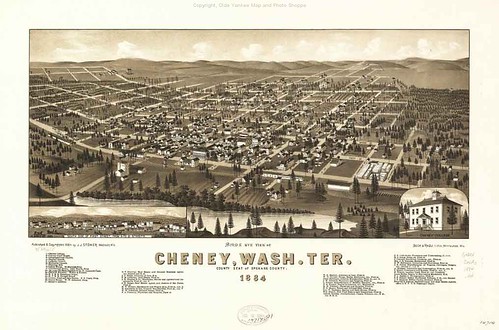
The map is captioned "Spokane Falls, W. T., 1884." Maps such as these, called "Bird's Eye" or panoramic maps, were popular in the late 19th century. Apparently a company that made them traveled through eastern Washington in 1884, as there are bird's eye maps of Cheney and Walla Walla from that year as well. The Library of Congress has a great web exhibit of its panoramic maps, along with a valuable set of essays for understanding the maps. It is important to remember that panoramic maps were created to promote development and investment and "not only showed the existing city but sometimes also depicted areas planned for development," according to an essay by John R. Hébert and Patrick E. Dempsey. So there are varying degrees of fiction and wishful thinking in these maps, and historians have to be careful using them.


The map pictured here is interesting because it pictures Spokane Falls at an early period. The city had only been incorporated three years before. And in 1889 the great fire would burn down most of the buildings rendered on the 1884 map. The city is a few blocks of brick and wood buildings, with a few more blocks of residences in each direction. The mighty Spokane River is drawn in full flood, crossed by spindly-looking bridges at Post and Howard Streets. It is a stark contrast to the better-known 1890 panoramic map of Spokane Falls, pictured below:

Or the 1905 panoramic map of Spokane:

...both of which show a more developed, commercial town well past the frontier city in the 1884 map.

Thursday, July 9, 2009

Duke Digital Collections iPhone App

I am not sure if this is an oddity or a glimpse of the future, but Duke Digital Collections has developed what I believe is the first iPhone app for a digital archive. The app is really nicely designed and takes advantage of many of the iPhone's capabilities. Here is the demo they put up on YouTube:


And yet--I can't see using my iPhone to do historical research. What do you think, dear readers? Is this a very impressive novelty or something more?

[Hat tip to the frequently valuable Duke Digital Collections Blog--a nice example of an institutional blog.]

Online Instruction Better than Traditional Classes?

The Evidence on Online Education - Inside Higher Ed: "Online learning has definite advantages over face-to-face instruction when it comes to teaching and learning, according to a new meta-analysis released Friday by the U.S. Department of Education. The study found that students who took all or part of their instruction online performed better, on average, than those taking the same course through face-to-face instruction. Further, those who took 'blended' courses -- those that combine elements of online learning and face-to-face instruction -- appeared to do best of all. That finding could be significant as many colleges report that blended instruction is among the fastest-growing types of enrollment."

(Here is the DOE Press release and here is the full report.)

I will have to read through the full report to see how they measure things, but the results sound right to me. My online students have typically done much better than my classroom students, scoring on average a full point higher on identical finals. (Or as I usually spin it, I have statistical proof that contact with me makes students dumber.)

Photo of AKAT-1, "a 1960s vintage Polish-designed analog computer"via Wikipedia.

Monday, July 6, 2009

Rethinking H-NET

H-NET is in decline. What should be done about it?

The Chronicle of Higher Education has an interesting article up right now. Change or Die: Scholarly E-Mail Lists, Once Vibrant, Fight for Relevance: "Once they were hosts to lively discussions about academic style and substance, but the time of scholarly e-mail lists has passed, meaningful posts slowing to a trickle as professors migrate to blogs, wikis, Twitter, and social networks like Facebook."

H-NET in in financial trouble as well. In an "open letter to our readers" the H-NET leadership cites declining revenue, aging servers, and other factors to encourage donations from H-NET users. I gave and so should you. At the same time I completely agree with Frank E. Reed's point that the last thing H-NET should be doing is replacing old servers to host their clunky legacy software. And finances are not the only problem at H-NET. As the Chronicle article points out H-NET suffers as well from declining relevance. The email lists have less and less traffic and have gone from being places of scholarly discussion to electronic bulletin boards--a worthwhile function, but a lesser one.

My career has tracked the rise of H-NET pretty closely, and H-NET has been a tremendous boon to me. Right out of grad school I took a 4/4 teaching job at an open-admissions state college in the rural Midwest. With few campus or travel resources, a heavy teaching load, no network of scholars in my field, and no expectation to publish, it was your classic black hole of a job--a place you go and no one ever hears of you again.

But I managed to stay in the game, and it was in part because of the H-NET listservs. I used the H-NET lists in my subfields to find people for conference panel proposals, test research ideas, make professional contacts for grants and such, and to keep my own name out there. I didn't become famous (and it isn't looking likely!) but to me H-NET was an absolute lifeline.

That said, H-NET never fulfilled its early (and perhaps unrealistic?) promise. A lot of us hoped that the H-NET lists would be places for scholarly conversations, the sort of exchange of ideas that happens across the lunch banquet table at the best academic conferences. This did sometimes occur, especially in the early days of H-NET. But by five years ago the lists had quieted down to become less discussion oriented and more like campus bulletin boards carrying academic announcements and the occasional bibliographic inquiry. Many lists seem to have faded away entirely as the traffic has moved to blogs, twitter, and other social networking sites with greater functionality.

Part of this might be a natural process, but at least part is due to the klunkiness of the H-NET software, which is a very 1980s legacy system with some patches. When you subscribe to a H-NET list you get a flurry of emails--1) a "Summary of resource utilization" ("CPU time: 0.004 sec Device I/O: 8," etc.), 2) a nine-item "Subscription Request Form" that you need to fill out and which includes such fields as "PLEASE WRITE A BRIEF PARAGRAPH ABOUT YOURSELF BY WAY OF INTRODUCTION: (Describing your research, teaching interests, or what you expect from the list, etc.)." and 3) a list of listserv commands ("2.) To unsubscribe, logon to the computer account from which you subscribed to the list, and send this message to listserv@h-net.msu.edu: SIGNOFF H-[listname]"). Though to be fair you can also go to the H-NET web portal to manage your subscriptions. It can make you crazy. (All I wanted was a Pepsi!)

As bad as the user interface is, the administrative interface for the list moderators is light years worse. I once trained to a moderator (then I irresponsibly flaked out on actually doing it--sorry, H-NET!) and was flabbergasted by the byzantine procedures of lopping off people's signature lines, knowing the right listserv commands, etc.

So what is to be done? My proposal is to take one H-NET list and its members and try to bring them into the 21st century. Begin by dumping the proprietary software and transferring the list to Google Groups (or something similar). Eliminate moderator's approval to post, which impedes the flow of ideas, but allow moderators to discipline and ban spammers and trolls.

At the same time, create a weblog for the list where every single subscriber has the ability to create a post. Such a multi-authored blog is quite unusual in academia but I have no idea why. Sites such as Metafilter, a "community weblog" with something like 80,000 members who can create posts, show that this model can create a vibrant online community.

And why stop there? Give the new H-NET list a Facebook page and a Twitter feed and a Delicious account.

This is a very different model for H-NET, and like most Web 2.0-ey innovations it relies on giving up control over what H-NET is. But is there really a choice here? To return to the Chronicle headline, the choice is to innovate or die. And H-NET is too important to let die.

Sunday, June 28, 2009

What Happens at THATCamp...


...gets Tweeted all over the world. (So watch yourself.)

I have just finished up at THATCamp, "a user-generated 'unconference' on digital humanities organized and hosted by the Center for History and New Media at George Mason University." It was a heady two days of presentations, debates, discussions and twittering about digital history with some of the most interesting people in the field. There was so much content and so many ideas it is hard to know what to blog. So rather than explore any one thing from the conference, I thought I would explain the "unconference" format of THATCamp and how it worked.

[And by the way, I hope THATCampers who read this will use the comments to correct me or make additions. I want this post to be a resource for next year's ThatCampers.]

Attendance at THATCamp is by application--you write a few paragraphs about what you will bring to share at THATCamp in terms of skills, experience, projects, or whatever, and also what you hope to learn. If you are accepted you receive an email with details about conference lodging and so on and als
o a user account to the THATCamp blog.

The blog is where the "user generated" part begins. People are encouraged to post their ideas on the blog and to use it to organize sessions. Many of us were not clear on this (and by "many of us" I mean myself) and participation on the blog was perhaps not what it should have been, but we did kick around some initial ideas. Here is my post.

On Saturday we came together at George Mason for breakfast. Along with coffee and baked goods there were three tables covered by large sheets of paper and handfuls of sharpies. The paper was divided into three large columns: Session Topic, Leaders, Attendees. The organizers had grouped the blog ideas into sessions and put down the names of the most voluble posters as the session leaders. We were encouraged to add ourselves as attendees or leaders or even to add new sessions.

We did this for half an hour and went to a sort of welcoming discussion. Twenty minutes later the staff had worked up a schedule for the weekend. We all bookmarked it on our iPhones and netbooks and filtered out to our sessions. (I thought about suggesting a printed copy but something told me that this just isn't done.)

The sessions were great. You know how at a regular conference you sit through the overly-long papers, checking your email and hoping that people stick to the time limit so you can get to the discussion? We skipped the papers. The sessions were extended discussions on digital history topics with people who are on the front lines of the digital revolution (and me).

Technology suffused the conference. The rooms were wired and included wireless signal. Usually someone would plug in a laptop to the digital projector and people would jump up to display a website or digital tool as it came up in the conversation. And there were power strips to plug in! More strips than there are snakes in Raiders of the Lost Ark.

Another thing that made the conference different was the use of Twitter, which was encouraged by the organizers. At THATCamp Twitter serves as a social organizer, a platform for exchanging information, and most of all a back channel of communication during the sessions. Nearly everyone had a computer or cell phone at hand and as we talked about digital history a second conversation was happening online. By using the hash tag #thatcamp in our tweets we could customize a Twitter feed (if you have a Twitter account you can see the conversation here, or visit an archive of all the 2500+ THATCamp tweets here). Many followed the conversation online using the free application Tweetdeck. It might sound odd to anyone unaccustomed to the technology but Twitter really was an effective and natural tool for enhancing the conversations. Occasionally someone would say "Now Susan just made a good point in her tweet [paraphrases Susan] what do we think of that?"Another interesting effect of Twitter is that quite a few digital humanists not at the conference took part in the Twitter conversations.

One additional innovation was the series of three minute presentations during lunch, which were lovingly titled "Dork Shorts." People signed up to give three-minute presentation of their digital projects. It was enough time to give a taste of the project but short enough that everyone who wanted to could show off their work.

The one other thing worth mentioning about the conference format was the variety of attendees. We had people from museums and libraries as well as academics, and undergraduates and graduate students mixed with university faculty and staff. It was very democratic and welcoming.

The "unconference" format of THATCamp gave me a lot of food for thought. The format was not perfect. Some of the conversations wandered too much, a few of the session organizers spoke a bit longer than necessary, and it took half a day for everyone to get in the groove of the unconference. But it was so much better than any other conference I have attended lately. I walked away from THATCamp not only with a lot of new knowledge and ideas but with a sense of having made meaningful connections with a bunch of digital history people. One of my goals is to bring the Pacific Northwest History conference to Spokane one year (oh God, did I just say that?) and I like the idea of adapting some of the unconference techniques to a regional history conference.

THATCampers--what did you think of the format? What did I miss?

[The picture of the Dork Shorts board is from CHNM director Dan Cohen's blog, Found History, which has his end-of-conference impressions of the event.]