I am a huge fan of the Internet Archive--often referred to by its URL, Archive.org. The Internet Archive is a non-profit dedicated to "universal access to all knowledge." They have a dizzying array of audio and video recordings, an ebook interface that is far superior to that of Google Books, and a "Wayback Machine" that allows you to view webpages that have since been deleted. This brief video highlight some of their work--and their elegant server farm. Enjoy:
Internet Archive from Deepspeed media on Vimeo.

Thursday, May 9, 2013


Friday, May 3, 2013
Spokane Historical's Guide to Dropping Out of the Bloomsday Race
Bloomsday, Spokane's annual 12k run, is this Sunday. About 40,000 close friends will converge on Spokane to race on a beautiful course that will include such Spokane wonders as Riverfront Park, views of the falls, the Peaceful Valley neighborhood, and Riverside State Park. And along the way they will pass a lot of important historical sites.

If you are one of the thousands of people who walks the route instead of running, I have a suggestion. Take your smartphone, download the Spokane Historical Smartphone app, and turn your water breaks into learning opportunities. Better yet, abandon the race and just explore the history of Spokane. Here is some of what you will discover:
Starting Line: You and your 40,000 friends are going to spend a while waiting for the race to begin, and fortunately Riverside is one of Spokane's more historic streets. Take a few minutes with Spokane Historical to learn about the Great Spokane Fire of 1889 and landmarks like the Davenport Hotel and the Great Western Building.
Mile 1: Still on Riverside Avenue, you are now skirting the edge of the historic Browne's Addition neighborhood. Look up at the MAC (the Northwest Museum of Arts & Culture for you out-of-towners). Consider dropping out of the race in favor of a more genteel walking tour of Browne's Addition. Or stop at the Elk for a Bloody Mary. You don't have to run.
 Mile 2: Having ignored my suggestion to drop out a mile back, you are now puffing up a hill above People's Park--which served as a special campground for hippies and the like during Expo 74. This was the only time that hippies were welcome in Spokane.
Mile 3: Now you are running past Greenwood Cemetery, a classic Victorian burial ground. Get off the rat race and explore this magical place with Spokane Historical. Learn about Spokane Garry, Spokane's Civil War Veterans, Mary Latham, and the mysterious hidden tunnel.
Mile 4: To your left is Fort George Wright. This historic site was home to black soldiers, and a totem pole. In 1911 Teddy Roosevelt gave a speech here--listen to a recording.
Mile 5: As you huff up Doomsday Hill, look out to where Natatorium Park used to be. Don't you wish you were there now?
Mile 6: The West Central neighborhood is Spokane's poorest neighborhood, but also the site of some spectacular mansions such as the Glover House and the Richardson House.
Mile 7: It is never too late to quit! Check out the historic Spokane Courthouse. Or continue across the iconic Monroe Street Bridge. Learn what the falls meant to the Spokane Indians and read Sherman Alexie's wonder poem and art project That Place Where Ghosts of Salmon Jump.
Did you finish the race? Very well then--but spend some time walking around the downtown with Spokane Historical. We have over 250 Spokane stories online and on your smartphone!

If you are one of the thousands of people who walks the route instead of running, I have a suggestion. Take your smartphone, download the Spokane Historical Smartphone app, and turn your water breaks into learning opportunities. Better yet, abandon the race and just explore the history of Spokane. Here is some of what you will discover:
Starting Line: You and your 40,000 friends are going to spend a while waiting for the race to begin, and fortunately Riverside is one of Spokane's more historic streets. Take a few minutes with Spokane Historical to learn about the Great Spokane Fire of 1889 and landmarks like the Davenport Hotel and the Great Western Building.
Mile 1: Still on Riverside Avenue, you are now skirting the edge of the historic Browne's Addition neighborhood. Look up at the MAC (the Northwest Museum of Arts & Culture for you out-of-towners). Consider dropping out of the race in favor of a more genteel walking tour of Browne's Addition. Or stop at the Elk for a Bloody Mary. You don't have to run.
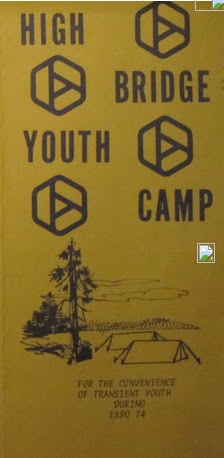 Mile 2: Having ignored my suggestion to drop out a mile back, you are now puffing up a hill above People's Park--which served as a special campground for hippies and the like during Expo 74. This was the only time that hippies were welcome in Spokane.
Mile 3: Now you are running past Greenwood Cemetery, a classic Victorian burial ground. Get off the rat race and explore this magical place with Spokane Historical. Learn about Spokane Garry, Spokane's Civil War Veterans, Mary Latham, and the mysterious hidden tunnel.
Mile 4: To your left is Fort George Wright. This historic site was home to black soldiers, and a totem pole. In 1911 Teddy Roosevelt gave a speech here--listen to a recording.
Mile 5: As you huff up Doomsday Hill, look out to where Natatorium Park used to be. Don't you wish you were there now?
Mile 6: The West Central neighborhood is Spokane's poorest neighborhood, but also the site of some spectacular mansions such as the Glover House and the Richardson House.
Mile 7: It is never too late to quit! Check out the historic Spokane Courthouse. Or continue across the iconic Monroe Street Bridge. Learn what the falls meant to the Spokane Indians and read Sherman Alexie's wonder poem and art project That Place Where Ghosts of Salmon Jump.
Did you finish the race? Very well then--but spend some time walking around the downtown with Spokane Historical. We have over 250 Spokane stories online and on your smartphone!
Sunday, April 28, 2013
Mullan Road Conference Next Weekend!

Named after its builder Captain John Mullan, the road crossed the Continental Divide to connect the headwaters of navigation on the Missouri and Columbia Rivers. The wagon road was begun in 1859 and completed in 1862. In a very real sense, the Mullan Road completed the work begun by Lewis and Clark as they searched for a practical route to the Pacific Ocean.
Also much like Lewis and Clark, the Mullan Road is a bit overrated. The road only served for a few years before being closed by winter avalanches and washouts. Parts of the road continued to be used, right to this day, but long stretches are all but forgotten. Though the Mullan Road has a fascinating history it is hardly the equivalent of the Oregon Trail or other great western roads.
Still, the road attracts continuing interest from a mixed community of academics and history buffs. Each year we get together at a site along the road to share our research, look at pictures of ruts, see the local historical sites, and on Sunday to explore a section of the road--when it can be located at all. This year the conference will be held at the MAC, where we will break our sessions with a tour of the excellent David Douglas exhibit. And on Sunday we will explore the trail from the Snake River to the Idaho line.
Registration is a bargain at $60, or $20 without the meals! Come join us.
Friday, April 19, 2013
At the NCPH Conference in Ottawa
I am at the 2013 Annual Meeting of the National Council on Public History. Unlike the last few years, I am not going to try and blog the experience. I am learning so much here--about interesting digital projects, about teaching public history, and about interesting partnerships. Some of it will show up in this blog later on.
I also participated in two sessions, a Working Group about best practices for universities wanting to create a public history program, and to present about using mobile apps in a public history program with the example of Spokane Historical. Both were were interesting sessions and packed. The Working Group is a new experience for me, we will work with the NCPH leadership to produce a "best practices" document, a sort of how-to guide for departments interesting in creating a public history program.
I also participated in two sessions, a Working Group about best practices for universities wanting to create a public history program, and to present about using mobile apps in a public history program with the example of Spokane Historical. Both were were interesting sessions and packed. The Working Group is a new experience for me, we will work with the NCPH leadership to produce a "best practices" document, a sort of how-to guide for departments interesting in creating a public history program.
Wednesday, April 17, 2013
Was Grandpa a Scab?
Note: Are you a westerner with ancestors from Missouri? The following guest post from Jarod Roll of the University of Sussex might explain your family tree. Roll was a student of mine back in the day at Missouri Southern State University in Joplin, where he developed an interest in the labor history of the region. The following post comes from his current research on the use of strike breakers in the mining west.
Mine owners in Idaho’s Coeur d’Alene district ran a remarkable classified ad in local newspapers in June 1899. They needed 1,000 miners to work in their silver and lead mines. What job creators, you might think! But these were not new jobs. In May the mine owners, with the help of the state government and federal soldiers, had imprisoned most of the men who had previously dug the district’s metals in the infamous bullpen. In April the Coeur d’Alene locals of the Western Federation of Miners had gone on strike for union recognition and higher wages in the Bunker Hill & Sullivan mine in Wardner. While what happened is disputed, an April 29 union rally ended with the destruction of the Bunker Hill & Sullivan mill by dynamiters. The authorities quickly lowered the boom on the union. Governor Frank Steunenberg declared martial law, President William McKinley dispatched federal soldiers, all known union members and suspected radicals were detained without charge, and the military authorities instituted a permit system that effectively blacklisted foreign-born and union miners from working in the Coeur d’Alene. Such effective union-busting created a problem, however. Who would work in the mines? Help wanted!
What made the ad so remarkable was not the circumstances that necessitated it, but that the mine owners placed it in local newspapers in Joplin, Missouri, over 1,500 miles away. Why go so far, why Joplin? Located in Jasper County near Missouri’s border with Kansas and Oklahoma, Joplin was the heart of one of the nation’s leading metal mining districts. In the 1890s the district led the nation in zinc production and ranked third in lead. Joplin miners were good miners, used to working in hard ground, and did not belong to a union. This combination had led mine owners in Leadville, Colorado, to Joplin to find strikebreakers to cross WFM picket lines in 1896. It worked. In early 1897, mine owners in Ouray, Colorado, came to Joplin for strikebreakers. It worked again. By 1899, if you needed good, non-union miners willing to take on the
WFM, Joplin was the place to go. Joplin’s miners were the best strikebreakers money could hire.
Hundreds of Joplin miners took the offer of employment in Idaho. By late summer, their work had brought most of the mines back into production. Their labor not only reinforced the owners’ heavy-handed union-busting strategy but also encouraged them to permanently replace the foreign-born miners of the WFM with native-born, non-union men. What had been a majority immigrant workforce in 1898 was two-thirds native-born American in 1901. The Joplin miners also benefited Strikebreaking paid good wages! Many of the Joplin miners stayed on in Idaho. In 1904, for example, the owners’ employment agency reported that over 300 Missourians worked in the mines at Burke and Wallace, over 26% of the workforce. Some of the Joplin men went back to Missouri. Albert Torr, for example, used his earnings from strikebreaking to buy an interest in a Joplin mine. Others continued strikebreaking. In 1903, over 100 Joplin miners left Idaho to take strikebreaking work in Cripple Creek,
Colorado.
Joplin strikebreakers left a poisoned legacy. Union miners rightly despised them. In Colorado, union miners coined a new phrase to describe the seeming ignorance and servility of Joplin strikebreakers: “I am from Joplin, you’ll have to show me.” Joplin miners would do anything their employers asked, the story went, but they were so ignorant that they had to be given careful instruction, to be shown. “Show me” began life as a term of opprobrium. In Idaho, “Joplin” and “Missourian” became synonyms for “scab,” or “cut-rate laborer.” Coeur d’Alene union miners even wrote a song, “Strike Breaker’s Lament,” that imagined the last words of dying Missouri strikebreaker:
I wish I was in Joplin, in Joplin down in Mo. . . .
Just then his voice it faltered, he ceased to murmur low,
His soul it went a-scooting to Joplin, Joplin, Mo.
His partner wept above him, and sadly fell his tears,
Then tried to drown his sorrow by drinking many beers;
He boxed the stiff and shipped him, as fast as he could go,
To the land of scabbing miners in Joplin, Joplin, Mo.
The mine owners got their 1,000 miners from Joplin in the end. Many of them stayed in Idaho. If you live there, look at your family tree. Do you have any ancestors from Missouri? If so, there is a good chance that they were scabs.
Jarod Roll teaches American History at the University of Sussex in Brighton, England. He is the author of Spirit of Rebellion: Labor and Religion in the New Cotton South and coauthor of The Gospel of the Working Class: Labor’s Southern Prophets in New Deal America. He earned his BA at Missouri Southern State University in Joplin, Joplin Mo.
 |
1900 advertisement in Miners Magazine,
the publication of the Western Federation
of Miners. From the Clarence Darrow
Digital Collection. |
What made the ad so remarkable was not the circumstances that necessitated it, but that the mine owners placed it in local newspapers in Joplin, Missouri, over 1,500 miles away. Why go so far, why Joplin? Located in Jasper County near Missouri’s border with Kansas and Oklahoma, Joplin was the heart of one of the nation’s leading metal mining districts. In the 1890s the district led the nation in zinc production and ranked third in lead. Joplin miners were good miners, used to working in hard ground, and did not belong to a union. This combination had led mine owners in Leadville, Colorado, to Joplin to find strikebreakers to cross WFM picket lines in 1896. It worked. In early 1897, mine owners in Ouray, Colorado, came to Joplin for strikebreakers. It worked again. By 1899, if you needed good, non-union miners willing to take on the
WFM, Joplin was the place to go. Joplin’s miners were the best strikebreakers money could hire.
 |
In 1899 some miners went so far as to dynamite the
works of this Kellogg mine. Joplin strikebreakers
entered a volatile environment.
|
Joplin strikebreakers left a poisoned legacy. Union miners rightly despised them. In Colorado, union miners coined a new phrase to describe the seeming ignorance and servility of Joplin strikebreakers: “I am from Joplin, you’ll have to show me.” Joplin miners would do anything their employers asked, the story went, but they were so ignorant that they had to be given careful instruction, to be shown. “Show me” began life as a term of opprobrium. In Idaho, “Joplin” and “Missourian” became synonyms for “scab,” or “cut-rate laborer.” Coeur d’Alene union miners even wrote a song, “Strike Breaker’s Lament,” that imagined the last words of dying Missouri strikebreaker:
I wish I was in Joplin, in Joplin down in Mo. . . .
Just then his voice it faltered, he ceased to murmur low,
His soul it went a-scooting to Joplin, Joplin, Mo.
His partner wept above him, and sadly fell his tears,
Then tried to drown his sorrow by drinking many beers;
He boxed the stiff and shipped him, as fast as he could go,
To the land of scabbing miners in Joplin, Joplin, Mo.
The mine owners got their 1,000 miners from Joplin in the end. Many of them stayed in Idaho. If you live there, look at your family tree. Do you have any ancestors from Missouri? If so, there is a good chance that they were scabs.
Jarod Roll teaches American History at the University of Sussex in Brighton, England. He is the author of Spirit of Rebellion: Labor and Religion in the New Cotton South and coauthor of The Gospel of the Working Class: Labor’s Southern Prophets in New Deal America. He earned his BA at Missouri Southern State University in Joplin, Joplin Mo.
Thursday, April 11, 2013
Spokane Ghost Signs Update
 |
| Surely not *that* Henry George? |
Today ended the second week of History 407: Research Methods in Local History. What a great day we had! The course met at the old Schade Brewery building in the West Central neighborhood, near Riverpoint campus. We explored the lobby and the historic photograhs there, then headed over to the Jensen Byrd. Students worked in teams of two, one with a clipboard and the other with a camera to record the signs the we found. Then the teams fanned out and explored the neighborhood.
Afterwards we had some beers at Ugly Betties and talked about what we had found and how to improve our data collection. Some of the observations:
- An amazing number of legible signs still exist, and they are cool as hell
- There are also many traces of signs that are no longer readable--we will look for historic photos to try and figure out what they said
- Photographing the signs is tricky, some are up high and at angles where they are not visible directly below, other are obscured by power lines and the like
- Signs for hotels and tobacco produces predominated with about five of each
- Working in teams is definitely the right way to proceed, not only so one can take pictures and the other notes but also to help one another deciper faded lettering
- We cannot wait to get into the archives and begine researching the stories behind the signs, which we will find in city directories, property record cards, register nominations, and more
Below is a slideshow of some pictures I took. The first half are from a few weeks ago when I was scouting for this class, today's photographs begin with the Schade brewery.
Discounted Student Rate at Revitalize WA Conference
This announcement just in--looks like a great conference, and I am so pleased to see a heavily-discounted student rate.
The Washington Trust for Historic Preservation will hold its annual RevitalizeWA conference in Vancouver, Washington, May 15-17, 2013. This year, the Washington Trust is offering a discounted rate of $75.00 for student registration down from the $155.00 basic conference registration.
The RevitalizeWA 2013 conference will feature a variety of engaging educational sessions, workshops and tours related to preserving and rehabilitating Washington’s historic places and revitalizing Washington’s historic downtowns all geared toward inspiring and informing attendees. Topics to be covered include: preservation of historic theaters, heritage tourism trails, retail market analysis for Main Streets, tools for effective preservation advocacy, using federal rehabilitation and low income tax credits to redevelop historic buildings, improving your financial reporting system to rethink your non-profit, creating engaging tours of Midcentury Modern commercial buildings in your downtown, modeling best practices and collaboration in preserving Seattle’s Trinity Parish Church, using CDBG grants for storefront improvements, how to engage youth and diverse audiences in preservation and revitalization, successful adaptive reuse of industrial and large commercial sites, and what’s next for Main Street? Keynote speaker, Charles Marohn, Executive Director of Strong Towns, will introduce a new model for community growth and sustainable development.
The Washington Trust will welcome preservation, heritage, and Main Street professionals, board members, volunteers, small business owners, city and regional planners, elected officials, design and building trade professionals, community and economic development specialists, educators, students, and local community members. Not only is this a great educational opportunity but a chance to network with others from across the state. More information about the conference, including a preliminary schedule, can be found on our website at http://preservewa.org/
In order to take advantage of this offer, simply visit the Eventbrite online registration at http://revitalizewa2013.
Tuesday, April 2, 2013
Giving a Talk Wednesday Night
On Wednesday, April 3 at 6 p.m. I will be at the Spokane Valley library to talk about digital approaches to telling local history stories, with a focus on Spokane Historical. Find out what Bert from Sesame Street and Osama Bin Laden have in common!


Thursday, March 28, 2013
Inlander Video on the History of Liberty Park
The Inlander is our local alternative weekly, and lately they have been producing local history videos. Below is the latest installment, featuring recent EWU public history grad Tracy Rebstock. Last year Rebstock researched the history of Spokane's parks for a series of stops for Spokane Historical. It is nice to see her hard-earned expertise in the subject being recognized in this video:
Wednesday, March 27, 2013
Google Don't Give a Shit. Maybe it Should
An update on my attempts to get Google to take down PhD in History, a Google-hosted blog that consists entirely of posts stolen from other history blogs, including this one. I filled out a form from here pointing to one of the purloined posts, the Ground Coulee dam one, and asked that the whole blog be removed. Instead Google deleted only that one post.
I went back and forth with Google, or an autobot at Google. I asked again that the whole blog be removed, they replied I needed to fill out a new form for each copied post. I pointed out again that the whole blog was copied and that filling out a 4-5 page form for each post was hardly practical. They replied again that I had to fill our a separate form and initiate a new request for each stolen post, and they are not going to do diddly until I do. And please remember that "we do not accept add-on requests."
I gave some thought to actually setting aside a few hours and filing a take down request for every stolen post. But what is the point? Clearly the blog PhD in History (and no I am not linking) is produced by some sort of software program. Others will follow, if they don't exist already. If I spend the time to get PhD in History, or at least all of its posts, taken down, a new blog will pop up in a day or two with the same stolen content. And Google will remind me that "we do not accept add-on requests."
In the end, this is Google's problem, not mine. If they want Blogger to become the platform of choice for a new kind of theft, who am I to criticize?
Also--despite the ink I am spilling here I don't really care all that much. This is a pretty obscure piece of theft and does me no real damage. Google and me--we don't give a shit.
 |
| "Yes we host your copyrighted material. So?" |
I gave some thought to actually setting aside a few hours and filing a take down request for every stolen post. But what is the point? Clearly the blog PhD in History (and no I am not linking) is produced by some sort of software program. Others will follow, if they don't exist already. If I spend the time to get PhD in History, or at least all of its posts, taken down, a new blog will pop up in a day or two with the same stolen content. And Google will remind me that "we do not accept add-on requests."
In the end, this is Google's problem, not mine. If they want Blogger to become the platform of choice for a new kind of theft, who am I to criticize?
Thursday, March 21, 2013
Ctrl+C, Ctrl+V, the Sincerest Form of Flattery
So I was trying to Google up some regional historical information and I found a great post at a blog I had not seen before--PhD in History. The post was excellent--bright writing, nice illustrations, and some good links. Though I had never visited the blog before, the writing seemed oddly familiar. Then it hit me-that is my writing! Those are my posts!
Some examples: Here is a post I wrote about the Grand Coulee dam. Here it is copied and pasted--images and all--to the offending blog. Here is another post from Northwest History, copied here. There are quite a few other of my posts copied at PhD in History. I am guessing that the posts not copied from my blog are stolen from other bloggers.
What is this? Some kind of aggregation bot? I don't see the point since there is not any advertising on the plagiarizing site. There is no author information at the other blog, or comments, or dates on the posts. Odd.
I am not sure if I even care about this very much. It is not like I am monetizing Northwest History content either, so maybe this is a case of no harm no foul? Just for the heck of it I filed a complaint with Google, and got back an auto reply that "we receive many such complaints each day; your message is in our queue." Also that they appreciate my patience!
Dear readers, have any of you seen this before, or have an idea what is going on?
 |
| Image borrowed from here. |
What is this? Some kind of aggregation bot? I don't see the point since there is not any advertising on the plagiarizing site. There is no author information at the other blog, or comments, or dates on the posts. Odd.
I am not sure if I even care about this very much. It is not like I am monetizing Northwest History content either, so maybe this is a case of no harm no foul? Just for the heck of it I filed a complaint with Google, and got back an auto reply that "we receive many such complaints each day; your message is in our queue." Also that they appreciate my patience!
Dear readers, have any of you seen this before, or have an idea what is going on?
Thursday, March 7, 2013
Sign Up Now for the Civil War Read In!
An innovative attempt to research the Washington Territory in the era of the Civil War is fast approaching, and we need more volunteers in eastern Washington! The training is on April 13, right here at the fabulous State Archives building in sunny Cheney. Details are below. We invite armchair historians, college students, genealogists, and really everyone to participate. Here are the details:
During the 150th anniversary of the Civil War, we in Washington know little of our own experience of the war. However, the war is not only of significance in the battlefield states, but also here in the far northwest, where settlers argued through the very same issues that tore the United States apart. As Washington State Historical Society prepares to launch a major exhibition, “Civil War Pathways,” in February 2014, we seek your help in learning more about Washington Territory during the antebellum, wartime and early Reconstruction periods.
Here are the Civil War Read-In Trainings
Saturday, February 9, 10-4 Seattle
Curious? Interested?
Join Washington’s Civil War Read-In!
 |
| Democratic appointee James Tilton arrived in Olympia, Washington Territory in 1855, accompanied by his family and a young black slave, named Charles Mitchell. Mitchell fled to the Crown Colony of Victoria in September 1860, a fugitive on a tiny Puget Sound underground railroad. Here, the San Francisco Daily Evening Bulletin, October 18, 1860, reprinted an article on the flight from a Washington Territory newspaper. |
In 2013, hundreds of researchers will fan out across Washington State, visiting
archives, museums and libraries to read the primary documents of our history,
1857-1871. We invite you to attend a training and to join the Read-In.
Participants will read an assignment in newspapers, classic published
histories, and archival material of all sorts. Join us to discover the
forgotten Civil War experience in Washington Territory, and report your
discoveries to make a permanent record – an on-line searchable database of
Civil War-era citations, hosted by the Washington State Historical Society.
During the 150th anniversary of the Civil War, we in Washington know little of our own experience of the war. However, the war is not only of significance in the battlefield states, but also here in the far northwest, where settlers argued through the very same issues that tore the United States apart. As Washington State Historical Society prepares to launch a major exhibition, “Civil War Pathways,” in February 2014, we seek your help in learning more about Washington Territory during the antebellum, wartime and early Reconstruction periods.
Get
involved!
- Attend a training, January through May 2013
- Take a Read-In assignment, in newspapers or documents
- Spend a month of spare time, carefully reading and gathering evidence (AND you have two months to actually do the work….)
- Document your reading in the project templates
- Upload your results to the Project’s Omeka database, hosted online by the Washington State Historical Society
Here are the Civil War Read-In Trainings
Saturday, February 9, 10-4 Seattle
Wednesday February
13, 10-4 Seattle
Saturday, February 16, 10-4 Vancouver
Saturday, February 23, 10-4 Olympia
Saturday, March 2, 10-4 Tacoma
SUNDAY, March 10, 12-6 Walla Walla
Saturday, March 23, 10-4 Yakima
Saturday, April 13, 10-4 Cheney
Saturday, April 20, 10-4 La Conner
Saturday, February 16, 10-4 Vancouver
Saturday, February 23, 10-4 Olympia
Saturday, March 2, 10-4 Tacoma
SUNDAY, March 10, 12-6 Walla Walla
Saturday, March 23, 10-4 Yakima
Saturday, April 13, 10-4 Cheney
Saturday, April 20, 10-4 La Conner
Saturday, April 27,
10-4 Seattle
We will
build a searchable database from your work, which will be available to all
researchers on the WSHS website. And we’ll also get all the readers together at
the conclusion of the Read-In, to meet one another and celebrate this great
accomplishment.
Curious? Interested?
Ready to
sign up for a training? Have any questions?
Tuesday, February 12, 2013
Mapping Spokane's Dead: A Pedagogical Experiment in Flash-mob Data Visualization
I taught Digital History last quarter. The course was a lot of fun as a dozen traditionally-trained MA students and I explored some of the new digital historical landscapes. The class is divided between readings discussions and a weekly "make" where we bust open some new digital tool and see what we can do with it. For our weekly make a few months ago we created, populated, and visualized a historical database in about an hour. This post is about what we did and how we did it.
I had a couple of different pedagogical goals.First, I wanted my students to understand the importance and power of constructing a database, rather than merely building a website. Second, I wanted them to explore one tool for doing so, Google Fusion Tables. Third,.I wanted to use some of the rich historical resources of my employer, the Washington State Archives, Digital Archives. Finally I wanted them to experience the difficulty, decisions and compromises of building a database and extracting metadata from handwritten historical documents.
Working with my grad student, the excellent Lee Nilsson, we chose the Spokane County Death Returns.1888-1907 as our data set. These records were interesting, the images of the death certificates and some metadata were already online, they represented a broad cross-section of the population of early Spokane, and they presented certain complications as well, in terms of handwriting and uneven data. Here is a sample death return from the collection, that of the unfortunate Owen J. Jones:

When the State Archives originally scanned and indexed these records, they chose to record as the metadata the first and last names, age at death, and place of death. This was a good start, but missed some data that was recorded on the death certificates and that historians would find important. So we added race, occupation, place of birth and cause of death to the metadata fields that we wanted to capture.
Then Nilsson created a Google Fusion table with our metadata fields and entered the information from a few death returns. Right away he realized that one problem the students would run into was transcribing the causes of death--things like phthisis (tuberculosis of the lungs) and morasumus (malnutrition) written in sometimes terrible 19th-century handwriting. A quick Google found us some lists of 19th century causes of death. Nilsson added about 150 names from the 1880 death index to the Google Fusion table and used color highlighting to organize the list in groups of ten names. I took the email addresses of the students in the class and gave them permission to edit the table.
The actual lesson took about an hour. We gave each student ten names and asked them to read the death certificates and to add the metadata to the table. Nilsson and I circulated in the classroom to help people out. The names and dates went pretty smoothly. The students stumbled with causes of death at first, but the guides to 19th century causes of death cleared up most questions. A bigger problem was missing data. 1880 was the first year of death records in Spokane and the record keeping was erratic. Places of birth, causes of death, and other items were not always filled out.
Then came the experiment part--visualizing the data. My original inspiration for the project was the idea that we would produce a map of where in Spokane people had died. This did not work so well:
In retrospect the reasons are clear. A few of the death certificates gave street addresses, and Google was able to map these accurately. In other cases no place was given, or given only as Spokane. In some cases there was a location but the student transcribing was unable to read it or just did not bother. With better instruction and monitoring this map might have come out better.
Google Fusion tables allow for other types of visualization as well. Here is a pie graph of causes of death:
Those are some mighty thin slices of pie! The chart does not tell us very much, except that typhoid and pneumonia were common. We would have been better off creating categories--contagious disease, accidents, infant death, etc.
You can also make bar graphs--here is one for the occupations of the deceased. The laboring classes seem to have had it bad in early Spokane, though you would need some demographic analysis to make any conclusions here:
Finally, here is the a frequency showing the distribution of deaths throughout the year. The table is interactive, you can click and drag to explore it. Notice anything odd? The Grim Reaper seems to have forgotten Spokane entirely some months:
The students were quite puzzled by this and came up with all sorts of reasons that several months could have passed without a death. Of course the most likely explanation is simply that the records for those months have gotten lost in the century since they were initially recorded.
All in all this pedagogical experiment was a great success. My students learned how digital sausage is made--the decisions that go into choosing what metadata to record and visualize, the challenges of working with hand-written 19th-century documents, the amount of pain-staking work that went into a data visualization.
I had a couple of different pedagogical goals.First, I wanted my students to understand the importance and power of constructing a database, rather than merely building a website. Second, I wanted them to explore one tool for doing so, Google Fusion Tables. Third,.I wanted to use some of the rich historical resources of my employer, the Washington State Archives, Digital Archives. Finally I wanted them to experience the difficulty, decisions and compromises of building a database and extracting metadata from handwritten historical documents.
Working with my grad student, the excellent Lee Nilsson, we chose the Spokane County Death Returns.1888-1907 as our data set. These records were interesting, the images of the death certificates and some metadata were already online, they represented a broad cross-section of the population of early Spokane, and they presented certain complications as well, in terms of handwriting and uneven data. Here is a sample death return from the collection, that of the unfortunate Owen J. Jones:

When the State Archives originally scanned and indexed these records, they chose to record as the metadata the first and last names, age at death, and place of death. This was a good start, but missed some data that was recorded on the death certificates and that historians would find important. So we added race, occupation, place of birth and cause of death to the metadata fields that we wanted to capture.
Then Nilsson created a Google Fusion table with our metadata fields and entered the information from a few death returns. Right away he realized that one problem the students would run into was transcribing the causes of death--things like phthisis (tuberculosis of the lungs) and morasumus (malnutrition) written in sometimes terrible 19th-century handwriting. A quick Google found us some lists of 19th century causes of death. Nilsson added about 150 names from the 1880 death index to the Google Fusion table and used color highlighting to organize the list in groups of ten names. I took the email addresses of the students in the class and gave them permission to edit the table.
The actual lesson took about an hour. We gave each student ten names and asked them to read the death certificates and to add the metadata to the table. Nilsson and I circulated in the classroom to help people out. The names and dates went pretty smoothly. The students stumbled with causes of death at first, but the guides to 19th century causes of death cleared up most questions. A bigger problem was missing data. 1880 was the first year of death records in Spokane and the record keeping was erratic. Places of birth, causes of death, and other items were not always filled out.
Then came the experiment part--visualizing the data. My original inspiration for the project was the idea that we would produce a map of where in Spokane people had died. This did not work so well:
In retrospect the reasons are clear. A few of the death certificates gave street addresses, and Google was able to map these accurately. In other cases no place was given, or given only as Spokane. In some cases there was a location but the student transcribing was unable to read it or just did not bother. With better instruction and monitoring this map might have come out better.
Much more satisfying was this map of where the people were born. It nicely illustrates patterns of migration into 19th century Spokane. Don't miss the guy from China!
Google Fusion tables allow for other types of visualization as well. Here is a pie graph of causes of death:
Those are some mighty thin slices of pie! The chart does not tell us very much, except that typhoid and pneumonia were common. We would have been better off creating categories--contagious disease, accidents, infant death, etc.
You can also make bar graphs--here is one for the occupations of the deceased. The laboring classes seem to have had it bad in early Spokane, though you would need some demographic analysis to make any conclusions here:
Finally, here is the a frequency showing the distribution of deaths throughout the year. The table is interactive, you can click and drag to explore it. Notice anything odd? The Grim Reaper seems to have forgotten Spokane entirely some months:
The students were quite puzzled by this and came up with all sorts of reasons that several months could have passed without a death. Of course the most likely explanation is simply that the records for those months have gotten lost in the century since they were initially recorded.
All in all this pedagogical experiment was a great success. My students learned how digital sausage is made--the decisions that go into choosing what metadata to record and visualize, the challenges of working with hand-written 19th-century documents, the amount of pain-staking work that went into a data visualization.
Wednesday, January 30, 2013
The Importance of Digital Archives
Last year we hosted a film team at the Washington State Archives. They made three films about our work. Here is the first--I am really pleased with how it came out.
Saturday, January 19, 2013
Superb Local History Video from the Inlander
Spokane is fortunate to have a very good alternative weekly, The Inlander. The newspaper has often run local history articles, but this is their first history video:
I love the use of oral history and reminiscences in this piece. The Park Inn is a few blocks from my home and I drive by it every week, never having an idea of the rich history.
I love the use of oral history and reminiscences in this piece. The Park Inn is a few blocks from my home and I drive by it every week, never having an idea of the rich history.
Subscribe to:
Posts (Atom)