Showing posts with label publishing. Show all posts

Wednesday, May 29, 2013

Hacking the Academy--Now in Print

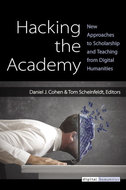
Hacking the Academy is now available in print. Hacking is the product of a digital humanities experiment to write a book in a week, on the theme of "hacking the academy." The volume includes an essay from myself, a repurposed version of one of my most popular blog posts: "How to Read a Book in One Hour."  The book is released under the University of Michigan Press's new Digital Culture Books series.

I am very glad to see the volume and may adopt it in my next relevant class. I am not sure why it took this long to come out--we wrote the book in a week and waited two years for the print version!

That said, my initial description of the project holds: "Hacking the Academy is interesting for both its content and its approach to publication. The content focuses on "how the academy might be beneficially reformed using digital media and technology," particularly "writing that moved beyond mere complaints about the state of the academy into shrewd diagnoses and potential solutions." The essays are organized into three broad categories: "Hacking Scholarship," "Hacking Teaching," and "Hacking Institutions." The essays alternate between provocative big-picture, "this is how we ought to start doing things" pieces (such as David Parry's Burn the Boats/Books and Jo Gildi's terrific "Reinventing the Academic Journal") and more immediately practical pieces such as "Unconferences," a how-to guide by Ethan Watrall, James Calder, and Jeremy Boggs."

So go buy a copy--or read it here for free.

Wednesday, April 25, 2012

JSTOR is Not Our Friend; or, What Should a New Public History Journal Look Like?

[Update 5/10/2012] : NCPH Executive Director John Dichtl stopped by to offer some corrections to this post in the comments. Thank you John for setting the record straight.]

The big news at this year's meeting of the National Council on Public History was that the organization has come to a parting of ways with UC-Santa Barbara, the publisher of the Public Historian. Those interested can trawl through the archives for H-Public for details, but the short version is that the two organizations could not come to terms, and that the copyright for the journal apparently belongs to the university and they intend to keep it. So the NCPH is looking to start a new journal for its members. The conference public forum discussion are summarized in this blog post by Cathy Stanton, The Elephant in the Room.
Scene from NCPH via Flickr user David Blackwell

The necessity of starting a new journal provides a fantastic opportunity to rethink what a scholarly journal can be in the 21st century. My thoughts:
  • Whatever else we decide, it is vital that the new journal be open access. Currently the Public Historian is really only readable by members of the organization. Back issues are online but behind a JSTOR paywall and accessible only by folks with an academic affiliation. The NCPH gets some money from JSTOR for this arrangement (I don't know how much, but I guess in the low tens of thousands?). 
  • Whatever the benefits we get from closed access and a partnership with JSTOR, the costs are both huge and largely unrecognized. Every year, JSTOR turns away 150 MILLION attempts to read journal articles! Imagine the lost relevance when our articles cannot be read, blogged, tweeted, sent over Facebook, assigned in public school classrooms, accessed by poor working and amateur public historians in the thousands of tiny museums, archives, and historical societies. JSTOR is not our friend.
  • Also, refusing this opportunity to become open access will alienate many of the younger and more tech savvy members of the NCPH. A lot of us are increasingly uncomfortable with donating our labor in writing and reviewing articles for the benefit of a huge publishing industry that locks our knowledge away.
  • The objections to open access are misguided. One concern I have heard from NCPH leadership is that people join the organization specifically to get the journal. I think this is unlikely. People join for the conference, the networking, and the affiliation. 
  • At the same time, we must continue a print journal. We must not underestimate the attachment folks have to print. A university library of my acquaintance is pitching a bunch of never-read back issues of journals that are already on JSTOR to make space. Many of the professors there seem to think that this is the equivalent of the burning of the library at Alexandria. Whatever we do, a print journal for members has to come out of it.
  •  The new journal should not be like the old one. As much as I have learned from the Public Historian over the years, the real elephant in the room is that the journal's content has always been uneven. The conventions of the academic article are simply alien to what many public historians actually do. There are not enough good public history articles in the academic style to support two journals.
  • What I would like to see? A magazine-format journal that is open-access and publishes a range of items from semi-academic articles to interviews with public historians (I could use those in the classroom!), visits to institutions where public history happens ("behind the scenes" articles at Colonial Williamsburg, the Buffalo Bill Historic Center, the CHNM, the Smithsonian, Gettysburg, etc.), reviews, and who knows. Everything would be available online and for free, but a print version would go out to members unless they opted out. Could it also be distributed through bookstores, etc?
  • Our model for new NCPH journal could be the Atlantic magazine. Four years ago the Atlantic retooled with an "internet first" strategy. It put all of its content, including back issues, online for free, added blogs, interviews, and other web-only features, and used all of these to promote subscriptions and newsstand purchases. The result: increased print sales and profitability in an era when all its competitors are declining. We can do this!
 I am also interested to hear your thoughts--what should a new NCPH journal look like? Please comment.

Sunday, June 14, 2009

"What is Black and White and Red All Over?"

From the Daily Show, this cruel and funny visit to the New York Times seemed to continue the line of thought in my earlier post, The Death of Scholarly Publishing? [Disclaimer: I am a subscriber to the NY Times.]

The Daily Show With Jon StewartMon - Thurs 11p / 10c
End Times
www.thedailyshow.com
Daily Show
Full Episodes
Political HumorNewt Gingrich Unedited Interview

[Hat-tip to Facebook friend Katrina Gulliver.]

Tuesday, May 26, 2009

The Death of Scholarly Publishing?

The University of Michigan Press has announced that they will be "redefining scholarly publications in the digital age"--by which they mean they will no longer print books. Rather they will shift their resources to "digital monographs." You to have give them props for the positive spin in the press release. "Freeing the press, in large part, from the constraints imposed by the print-based business model will permit us to more fully explore and exploit ever-expanding digital resources and opportunities," Phil Pochoda, director of U-M Press, quotes himself as saying. Pochada also refers to his team and himself as "visionaries."

There is much fussiness in the academic community about this move, but it is not like we did not see it coming. Scholarly publishing of monographs has been on its death bed for years, with press runs of many books dropping below 1000, then below 500, then into the low hundreds even as prices have soared and subventions have become almost respected.

But as the guys over at Digital Campus pointed out in a recent podcast, the vital element of scholarly publishing is the peer review, not the physical form of the end product. Though no one seems to be noticing, academic articles have already made the leap. I am willing to bet the average article in the Journal of American History gets far more digital readers via the commercial databases such as the History Cooperative and JSTOR than through actual subscribers who crack open a physical copy.

And the digital versions of the articles are far superior to the printed ones. First of all you can actually find relevant articles via search engines. Then you can do keyword searches to take you to a relevant passage. You can store the articles you are working on in your laptop and mark them up with various tools. Within five years most of all of our history journals will cease publication in the dead-tree format.

But even I have to admit that the book poses special challenges.

First of all, we have no good delivery format for digital books. The Kindle solves many of the readability problems of digital publications, but it also locks away your content into a closed proprietary system. You don't actually own your books on a Kindle, you just pay Amazon for permission to read them. The Sony Reader does not seem to be catching on, and there is no open source reader that I know of. (Update: Not so fast...)

Second, will anyone buy digital scholarly monographs? Grad students are too broke and their professors too deep in their print fetish to buy digital books. And books have a somewhat different revenue model than scholarly journals, depending more on individual and less on institutional purchases. Journal subscription costs are largely borne by institutions, but books still generate some of their revenue via sales to individuals.

Third, authors who have a choice will go to publishers who print physical books until the last one closes shop. After all, what kind of gift to grandma is a digital book? The answer here is print-on-demand (POD) services to turn digital books into hard copies. One can imagine a bookstore that has exactly one hard copy of each title on its shelves. When you make a selection you bring the book to the clerk who punches a few buttons and a machine in the back spits out a lovely bound copy. In fact you have to imagine such a store, because none currently exist, despite developments such as the Espresso Book Machine. There are quite a few online POD vendors, and I was pleased with my experiment with one of them, but I don't think they represent any significant fraction of the book market.

So the transition to digital is apt to be trickier for books than it has been for journals. As university presses pull back and are closed down in the current economic crises (is LSU press next?) the search for a new model of scholarly publishing grows more urgent.