Tuesday, July 5, 2016

Of Carbolic Acid, Suicide, and Key Words

The 1903 Death Return for Carolyn Merrill hints at the tragedy that ended her short life. Death Records, Adams County Death Return, Washington State Archives, Digital Archives.
The 1903 Death Return for Carolyn Merrill hints at the tragedy that ended her short life. 

Last month I was working with State Archives employee Allie Honican to present some of our sources for historical research to an EWU history class. The multimedia room in the archives is decorated with framed reproductions of historic documents--including the 1903 death return above. Looking at it during a break in the training I spotted a clue that hinted at a darker story in the death of young Carolyn Merrill. Can you find the clue?

The cause of death was listed as "carbolic acid," which was a common household disinfectant back then, but also a deadly poison. For these reasons, it was commonly used by suicides at the turn of the century. Merrill had killed herself.

Allie, who is a wizard with the Google News Archive, quickly turned up the whole sad story. “Rejected Girl Ends Her Life,” blares a headline in the June 11 Spokesman-Review, “Parting Talk to Lover, Then Carbolic Acid.” It seems Merrill had been engaged to local tavern owner Joe Naffziger. He had broken off the engagement the night before. The story is poignant: “The young woman spent the night grieving for the love she had lost. On her person were found letters of farewell to Naffziger and her brother, saying that ‘she could not live without Joe’s love,’ and begging God to forgive her for the deed she was about to commit.”

Merrill's is not the only record to list carbolic acid as a cause of death. The death certificate of Kate Barrett, the Spokane prostitute who is sometimes blamed for starting the Great Spokane Fire of 1889, lists "suicide carbolic acid" as her cause of death.

I wanted to do a little research on carbolic acid and suicide. Unfortunately, the Washington State Archives, Digital Archives is not set up to allow searching records for causes of death. So I went over to the Chronicling America website, which has 11 million pages of digitized, OCRed newspapers, most from 1900-1920. A search for "carbolic acid" revealed the shocking frequency of this manner of suicide with 75,785 results for the search term, many of them stories about women (and sometimes men) committing suicide.


Contemporaries also noticed what appears to have been an epidemic of suicides by carbolic acid. In a 1904 article, "Carbolic Acid the Favorite Poison of the Despondent," a Minneapolis coroner notes that there had been 100 suicides in his city in the last three years, 59 by carbolic acid. He called for tighter regulation of the substance to reduce the epidemic of suicides. The City Marshall of Joplin, Missouri made a similar set of observations that same year. By the 1920s, closer regulation of carbolic acid seems to have greatly reduced the number of suicides by this method.

This macabre short history makes a larger point about historical research in the digital age. Even a few years ago, researching the history of carbolic acid and suicide during this time period would have involved months of tedious skimming of microfilmed newspapers, trying to catch the odd story here and there. Now, a quick keyword search brings tens of thousands of leads in an instance. Yet this is only possible because we have a fairly unusual set of keywords--carbolic and acid. Similarly, it is easier to do digital research for Spokane (there are two in the United States, and the other one is tiny) than it is for say Springfield (42 towns of places) or Riverside (186 place names).


Tuesday, June 28, 2016

Clyfford Still: The Colville Reservation and Beyond, 1934-1939

Here is a charming short documentary film about one of the best-known artists from the Inland Northwest, and how his relationship with native peoples shaped his work.

Clyfford Still is usually remembered as a pioneer in the abstract expressionist movement in painting. Today there is an entire museum in Denver dedicated to displaying his work. However, before he was a nationally famous painter, he was a local figure. Still graduated from Spokane University in 1933, and eventually became an art professor at Washington State University. Still participated in the Nespelum Art Colony (documented in this fine book), which brought painters from around the region to Nespelum, Washington on the Colville Reservation. This film shows how Still's early experiences on the reservation influenced his later work.


Type your summary hereType rest of the post here

Friday, May 27, 2016

The Real People: 1970s Documentary Series by and About Pacific Northwest Indians


I am often delighted and amazed by what pops up on YouTube. As  films are digitized, they often get loaded to YouTube. Old home movies, documentaries about regional history, clips of old TV shows, all once locked away on film reels housed in some basement or attic, become public again.

The Real People was a series of nine, 25-30 minute documentaries produced by and about Northwest native peoples in the mid-1970s. The movies were produced for KYRS-TV, which recently loaded them to their YouTube channel. Here they are:
  1. Real People: A season of grandmothers Ep. 1
  2. Real People: Circle of song #1 Ep. 2
  3. Real People: Circle of song #2 Ep. 3
  4. Real People: Mainstream Ep. 4
  5. Real People: Awakening Ep. 5
  6. Real People: Spirit of the wind Ep. 6
  7. Real People: Buffalo, blood, salmon, and roots Ep. 7
  8. Real People: Legend of the stick game Ep. 8
  9. Real People: Words of life, people of rivers Ep. 9
I wish I knew more about these films! All a quick search turns up is a few brief descriptions, such as this one from a 2001 book: "The Real People was an ambitious eight-part series developed in 1976 by KSPS-TV, a public television station in Spokane, Washington . . . . The series focused attention on lesser-known Indians located in the Northwest Plateau region of the United States. Among the tribes featured in the series were the Coeur D'Alene, Colville, Flathead, Kalispel, Kootenai, Nez Perce, and Spokane. George Burdeau was a consultant for The Real People series."

Burdeau turns out to be a veteran Native American filmmaker with a long list of credits, this series looks to be some of his earliest work.

Dear Readers, do any of you know more about these films?

Monday, May 16, 2016

What are Your Favorite Podcasts?

I do a fair bit of driving, and for the last couple of years have been relying on history podcasts to make the miles pass by. I have learned a lot about history and about storytelling. I also discovered that I am fairly picky--many popular history podcasts leave me cold. I like tight storytelling, concise conversations, and decent production values. I do not like listening to a couple of long-winded PhDs having a conversation over a poor telephone connection about who is more clever than the other. I particularly love the local, the off-beat, the unexpected.

I thought I would share a few of my favorites, and ask my readers
to share their own.
  1. The Memory Palace by Nate DiMeo is a series of tiny little jewels of storytelling. These short, quirky and intimate tales are  spellbinding. I love how DiMeo often takes the story in unexpected directions. DiMeo has a playlist of his favorites for new listeners, but I think you should start with Charlie, God of Rain.

  2. 99% Invisible by Roman Mars bills itself as a program "the unnoticed architecture and design that shape our world." Which is just some fancy words for history. Mars delves into all kinds of subjects, from the era when automobiles took over the streets (The Modern Moloch) to William Howard Taft's answer to the Teddy Bear (The Billy Possum).

  3. Backstory with the American History Guys is  a more conventional approach but extremely well done. Each episode, hosts Ed Ayers, Peter Onuf, and Brian Balogh explore a single topic across American history. Examples include American Spirit: A History of the Supernatural and Untrammeled: Americans and the Wilderness. The hour-long shows combine discussions from the hosts with interview with other historians, historic audio, field reports and questions from listeners. The website is rich with additional content.
     
  4. History Extra podcasts from the BBC feature European and world history. These are fairly staid, with most hour-long episodes consisting of two interviews with the authors of recent books. But the interviews are really well done, and God knows I could stand to learn some non-American history.
I have a few others that I listen to, but I am more interested in discovering some new podcasts. Dear Reader, what do you listen to?

Saturday, May 14, 2016

Pillars of the Sky: A Crazy Mess of a Historical Film


I hesitate to share this at all, but it is one of only two films I know of that are based on the 19th-century white-native conflicts on the Columbia Plateau. (The other is I Will Fight No More Forever, a 1975 TV movie about the Nez Perce War of 1877.)

Pillars of the Sky is a 1956 B-movie western, based on a 1953 novel, To Follow a Flag, by Henry Wilson Allen. Though ostensibly set in 1868 (apparently so the characters can reminisce about how they fought together in the Civil War) it is loosely based on the Yakima War (1855) and the Steptoe Expedition (1858).

The film is a classic western of the time, with an outlandish plot, a conflicted, hard-drinking western hero, the fallen woman who loves him, and some stereotypical Indians. Some of the native characters are quite loosely based on real historical individuals--Kamiakin (the film's villain), Timothy (a U.S. Indian scout in uniform!), a couple others. Two of the white characters are based on real folks, Dr. Joseph Holden is roughly Marcus Whitman (with no Narcissa in sight) and Col. Edson Stedlow = Col. Edward Steptoe. Most of the film is invented from whole cloth, but there is a climactic battle scene based on the Battle of Steptoe Butte. I am so surprised I'd never heard of this movie.

Dear Reader, I watched the whole thing so you would not have to. If you want to skip to the more interesting parts, I would fast forward to 1) 23:48, where Kamiakin storms into a gathering of chiefs and has an epic argument with Timothy about how the Indians should deal with the white men, 2) 56:00, the start of the Battle of Steptoe Butte sequence, and maybe 3) the ridiculous ending starting at 1:23:00 where Dr. Holden (Marcus Whitman) is murdered by Kamiakin (!) who in turn is slain by Couer D'Alene chief Isaiah (!!). It is to be noted that none of that last bit actually happened.

Here you go:


1956 - Pillars of the Sky - Jeff Chandler; Ward... by westerns_only

Wednesday, May 11, 2016

The Language This Land Remembers

One of the most exciting developments hereabouts on the Columbia Plateau is the ongoing revival of native cultures. Everywhere I go I meet native people who are building traditional canoes, reviving native foodways, bringing back lost animal species and recovering and teaching the native Salishan dialects of the northern Plateau.

The Language this Land Remembers is a wonderful short film about the Salish School of Spokane, whose mission is "to create a vibrant community of fluent speakers of Interior Salish languages by providing Salish language instruction to children and by empowering parents and families to speak Salish in their daily lives." Enjoy.
 

Wednesday, May 4, 2016

Ethnic Cleansing and the City Beautiful: The Case of Spokane

One of my many uncompleted (or more accurately, hardly begun) projects is about the ways that the white leaders of early Spokane worked to force American Indians out of the city limits. In the 1890s and 1900s Spokane's elites wanted to move past the image of a rowdy frontier town and tried to become a more refined and sophisticated city. This effort took many forms, from anti-spitting ordinances to creating libraries and city parks. This City Beautiful Movement had an uglier aspect as well--the forced removal of Indians from the streets of Spokane. The very same people who created our park system pushed for the removal of the people who had originally inhabited those parks, and for the very same reason--to make Spokane appear more modern.

Today I found another newspaper article to drop into my research file for this topic. "Officers Stop Indian Spree," screamed the front page of the Spokesman-Review on June 9, 1903. "Spokane Children Terrorized by Bad Red Men," the headlines continued, "ON A BIG DRUNK."

The story is the usual set of racist assertions that shaped western press coverage of Native Americans in this period, using some particularly ugly language which I will not quote. But reading the article against the grain, as it were, we pick out some interesting facts about American Indians and the City of Spokane at the time.

The article notes that the hot weather has brought "a big bunch of Indians" to Spokane, that Indian Agent Major Anderson was unable to prevent. It further notes that Indians were supposed to get a permit to leave their reservations, a system which was proving unenforceable.

The tribes included the Spokane, Nespelems, and Couer D'Alenes, who established three camps. The largest, with 40 Indians, was at "the north end of Monroe Street, just inside city limits." This seems to have been at Drumheller Springs. Another was "across the river from the army post" and a third was near Greenwood Cemetery.

I have found bits and pieces of information about these traditional camping spots before. Drumheller Springs was used by reservation Indians as a camping spot when they traveled to Spokane as late as the 1920s, according to Barry Moses in this video (story starts at 4 minutes in). This 1904 death return for an Indian man killed in a fall lists the location of the accident as "at his camp North Monroe Street" and seems to imply the same location.

The camp across the river from Fort George Wright is portrayed in this detail from the 1890 birds-eye-view map of Spokane:

The map key identifies this collection of
teepees as "Remnant of Spokane's Early Days."
The third camp is what would come to be called Indian Canyon. This camp is where Slough-Keetcha, known to most as Spokane Garry, lived his last days, and was occupied at least into the 1910s, as we see in this lovely glass plate slide created by the early Spokane Parks Department, taken sometime before 1913:


The rest of the article describes alleged native shenanigans including loud partying and stealing a white man's team of horses to extract a fee for recovering them. Both are remarkably mild offenses in Spokane in 1903, a city that was known for rowdy workers from the mines and timber camps and the saloons and brothels that served them. It was enough, however, to get local law enforcement agencies to unite and order the Indians to leave town. "If the Indians are not gone by today," the newspaper warns, "some of them will sleep in the county jail tonight."

So if we strip away the racism we get a remarkable portrait of native life in 1903. Indians seem to have regularly slipped away from the reservations to return to their traditional gathering spots along the river. There were three regular camps that were used for generations after white settlers had displaced the original inhabitants and forced them onto reservations. If Indians grew too visible in the city, by their activities or their numbers, law officials worked together to expel them from the city limits.

I was talking about this research topic years ago to a friend, who pointed out a sad, modern connection. Some of our city parks today offer refuge to Spokane's homeless population--a population where American Indians are over-represented.

So many research topics, so little time.

Thursday, April 28, 2016

I Am Finally Going to Get Some Skills!


I am delighted to announce that I will be one of the attendees this summer at Doing Digital History 2016. "The goal of Doing Digital History is to introduce established historians to new media methods and tools, and to increase their confidence and abilities in applying those methods and in reviewing digital scholarly work," according to the website. The two-week institute is designed to provide hands-on instruction and access to a professional learning community for participants." Here is the draft schedule.

Doing Digital History, I should add, is put on by the Roy Rosenzweig Center for History in New Media--the same outfit behind Omeka, Zotero, and other tools that I use all the time. Thanks, guys! It is funded by the National Endowment for the Humanities, Office of Digital Humanities.

Dear Reader, I have been leading a life of deception. I started blogging in 2007, and launched a local history smartphone app in 2012. Yet, I have no skills really--I do not code, or do GIS, or know Drupal from Joomla from a hole in the ground. I found some simple digital platforms developed by other people and I ran with them. My history colleagues sometimes think that I am some digital guru, but that is like impressing a four-year-old with a magic trick.

No longer, my friends. This summer I am getting some skills.

Tuesday, March 29, 2016

Dating a 100-Year-Old Photograph

[Note: The following is a story I wrote for Out of the Archives the newsletter of one of my employers, the Washington State Archives. If you enjoy this sort of thing you may want to subscribe to the newsletter, which is free and which features fresh historical content every month!]

The Washington State Archives holds tens of thousands of historic photographs. Many have excellent provenance--we know when and where the photographs were taken, who is in them, what agency held them before they were archived with us. Other times, not so much.

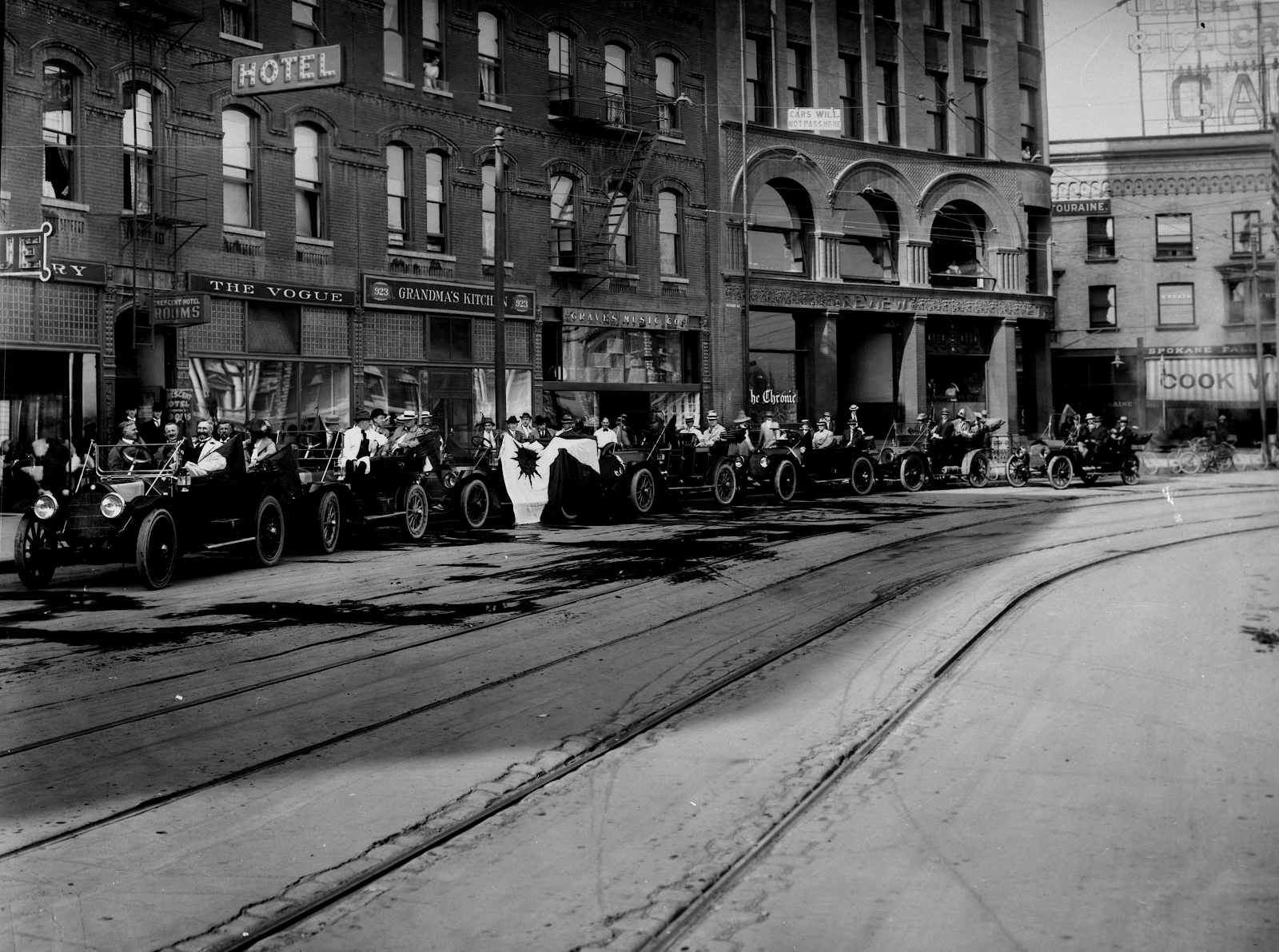
Caption: Convoy of Cars parked along Riverside Avenue displaying old City Flag,Spokane City Historic Preservation Office - Photographs, Washington State Archives, Digital Archives, http://www.digitalarchives.wa.gov.

Recently, Allie Honican, an EWU graduate student employee, brought this photograph to the attention of Assistant Digital Archivist Larry Cebula. A wonderful image, full of interesting details, it also had barely any information attached. The image is part of the Spokane Historic Preservation Office collection at the Digital Archives, and is dated “1900-1930.” No identification is made for the people in the photograph, or what obviously ceremonial event was taking place. (You can zoom in on the photograph at the Washington State Archives, Digital Archives here.)

They noticed, however, that the photograph includes many details that should allow historians to narrow down the date range. The location is obvious to any Spokane native--they are in front of the Spokesman-Review newspaper offices on Riverside Avenue. What else could we find out about the image?

Cebula shared the photograph on social media and the Internet Detective squad got to work. A friend with a strong knowledge of clothing styles though the image must be from the teens or early 20s. An automotive historian noticed that the automobile headlights were a mix of electric and carbide lanterns (towards the rear of the caravan), a combination that would have only been seen in the early 1910s. Another found a webpage with a history of the official Spokane flags, which revealed that the flag draped over an automobile in the center of this photograph was not used after 1912.

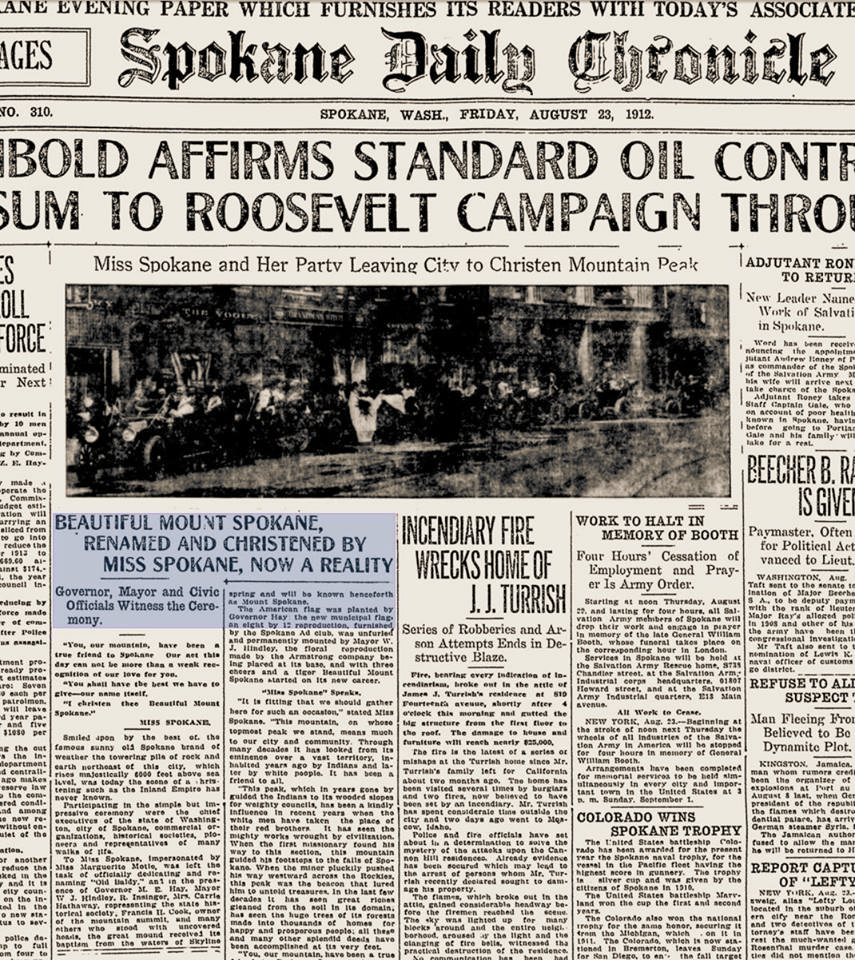
The hero of the hour, however, was our own sharp-eyed Benjamin Helle, archivist for the Olympia branch of the State Archives. With a probably date range of the early teens in mind, Helle zoomed in on the lead car and recognized Governor Marion E. Hay sitting in the center. From there he identified Francis Cook as the man behind the wheel. Helle knew that Cook was instrumental in the creation of Mount Spokane State Park around this time. A bit more sleuthing and he came up with this front page of the Spokane Chronicle newspaper for August 23, 1912. “Winner, winner, chicken dinner!” Helle crowed.


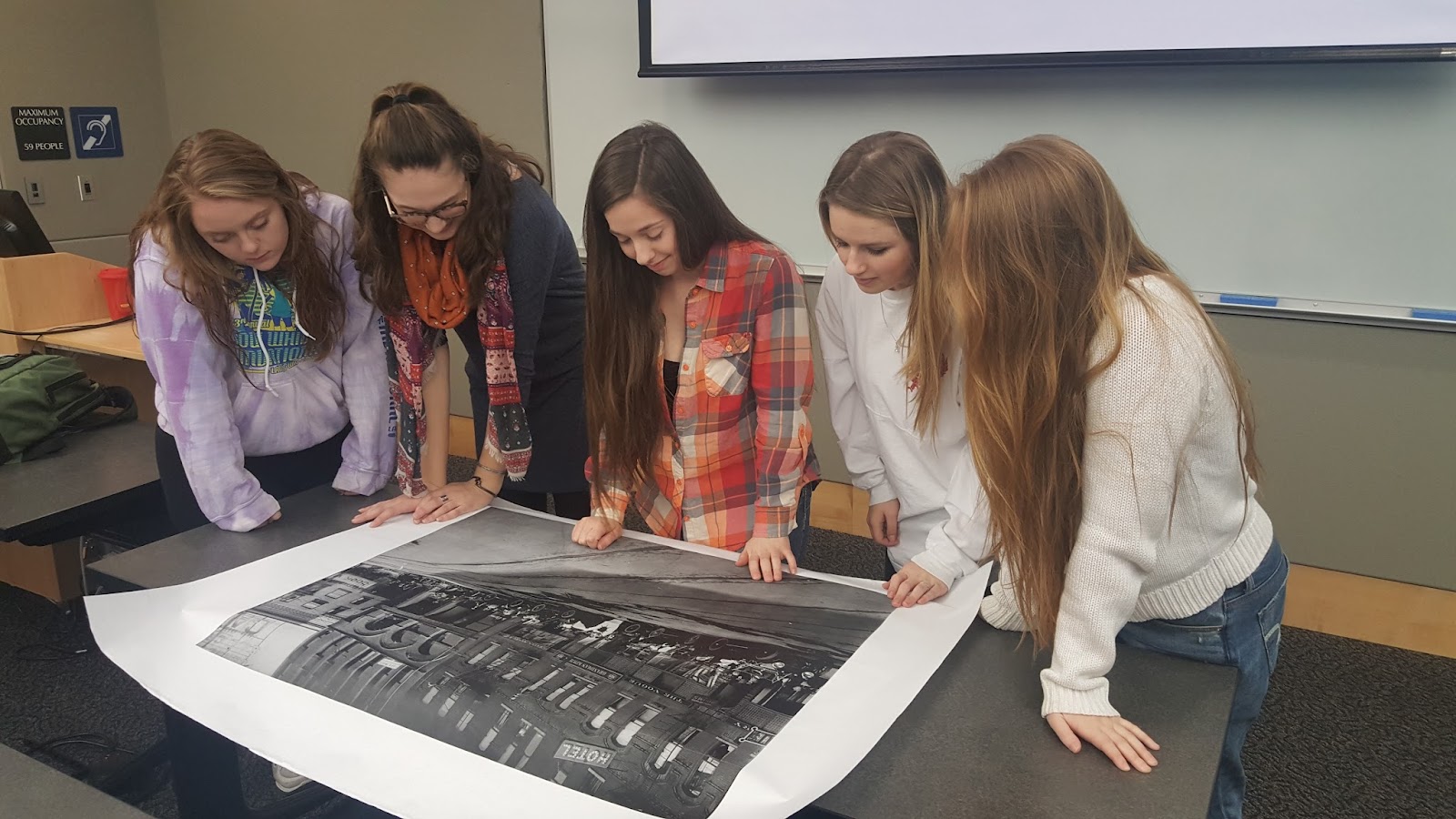
Cebula, who holds a joint appointment in the History Department at Eastern Washington University, decided that this was a teachable moment for his students. With the help of archivist Lee Pierce and EWU graduate student worker Logan Camporelle, he brought some students to the Eastern Region Branch, along with poster-sized print of the photograph. The students used city directories to look up the businesses seen in the background, finding what dates the Crescent Hotel, The Vogue, Graves Music Company and Grandma’s Kitchen were in business in those locations.

The “solving a mystery” aspect of the assignment drew the students in, even as they learned the nuts-and-bolts of doing local history research. They worked in teams to create a timeline for each business, and found that the photograph could only  have been taken in 1912 or 1913. From there Cebula lead them through some of the online resources and they were able to pin down the exact date as well.  “At first we didn’t think we’d be able to find out anything“ one student said, “but it was a lot of fun when we did!”

IMG_20160229_140730.jpg

Camporelle added the background information to the image in the online user comments, and Digital Archivist Debbie Bahn will soon amend the record description to include the names and exact dates. That is one photograph fully accounted for--a few thousands or tens of thousands to go!

Tuesday, March 8, 2016

Spokane Event: "Losing the West? Public Lands and Private Gain"


I wanted to make a quick post to inform Spokies of an upcoming event. I am going to be out of town so I am counting on you, dear reader, to attend in my place. Below is the description, including the details.

"Losing the West? Public Lands and Private Gain"
“Although the spirit of the American West remains an ideal to our national heritage,” says author and photographer Dave Showalter, “and many places remain wild and free, for the first time in our country’s short history, development has left many lands and waterways fragmented and scarred […] for short-term gains.”
Join Showalter and Paul Lindholdt, a professor at Eastern Washington University, for a discussion at the crossroads of the American West. Is a booming population and development bringing a new era of prosperity to the region, or permanently scarring the land that has so long captured the American imagination? In the era of Cliven and Ammon Bundy, how do we find a balance between public and private land use in the American West?
Speakers: Dave Showalter, nature photographer and author of Sage Spirit: The American West at a Crossroads; and Paul Lindholdt, professor of English at Eastern Washington University and author whose environmentally-focused work In Earshot of Water won the Washington State Book Award in 2012. Moderated by Shann Ray, American Book Award-winning author of American Copper.
When: 7:30 p.m., Wednesday, March 16, 2016
Where: Lindaman's Bistro, 1235 S Grand Blvd, Spokane, WA 99202